



Chateau de Champlatreux : The Most Stunning Wedding Venue Right Outside of Paris
There is a particular moment that happens when you turn off the highway north of Paris and the road narrows between rows of mature trees that have been growing here for centuries, and the château appears at the end of the allée with the Île-de-France countryside spread out behind it. I have experienced that moment multiple times, arriving at Château de Champlâtreux for different weddings across different seasons, and it never loses its effect.
The building rises from the parkland with the authority of something designed by a person who understood exactly what they were doing — the symmetrical façade, the central polygonal pavilion, the sculpted stonework, and the long park stretching beyond — and the cumulative impression is of a place that was built not for private habitation but for the very activity you are there to document: the grandest possible form of celebration.
In 17 years of photographing destination weddings across France and Europe, Château de Champlâtreux has become one of those venues I return to with genuine anticipation. I know where the best light falls in the salons at noon and at dusk. I know which angle in the Vestibule catches the marble floor and the gilded mirrors simultaneously.
I know the quality of the golden hour over the circular pond in September and the particular way the château’s limestone façade glows in June. I want to share all of that knowledge here — the history, the spaces, the photographic environments, and the practical details — so that any couple seriously considering Château de Champlâtreux has the most useful possible resource before they make one of the most significant decisions of their wedding planning process.
One of the the things I love most about this wedding venue is that it’s right outside of Paris, which I tend to stay at for long periods of time. Paris is the center of everything in France, so staying in Paris and being able to easily commute to this wedding venue is perfect and ideal for anyone of your guests.
The History: A Building Designed for Exactly This
Château de Champlâtreux was built between 1751 and 1757 by architect Jean-Michel Chevotet — a leading practitioner of the French Rococo tradition — commissioned by Mathieu-François Molé, Président à Mortier at the Parlement de Paris and one of the most powerful legal figures in 18th-century France. Molé used part of his wife’s considerable fortune to demolish the modest Louis XIII structure that had previously occupied the site and replace it with something that announced its owner’s position in French society with complete confidence.
The building was designed from the beginning as both a country home and a place for lavish entertaining. This is not a minor detail — it means that the four grand state salons on the ground floor were conceived with celebration in mind, that the proportion of reception space to private space is unusually generous, and that the whole organization of the building reflects a 270-year-old understanding of how to receive people at the highest level. The château was constructed with 23 bedrooms equipped with private dressing rooms, a scale of accommodation that placed it among the grandest country houses in the region.
The French formal gardens designed by Chevotet in the 1730s were later replaced in 1823 by a landscape park designed by the Thouin brothers — André and Gabriel Thouin, leading figures in the French landscape movement — creating the sweeping vista bounded by mature trees with the ornamental stone pond at its center that forms the garden view couples see from the salons today.
The château was pillaged during the French Revolution, restored in the 19th century by Mathieu Louis Molé, and eventually passed to the family of Noailles, where it has remained. The poet Anna de Noailles spent time here regularly in the early 20th century. Today the Duc de Noailles — ninth of that name — is the current custodian of the estate.
Château de Champlâtreux was classified as a Historic Monument in 1989, and the estate — including the château, the stables, and the park — is protected under that designation. The classification reflects not just the building’s architectural significance but its continuous connection to French cultural and political history across nearly three centuries. When I photograph a wedding here, I am working in a space with real historical weight, and the images reflect that — there is a depth to the setting that cannot be manufactured.
Why This Venue Is Different from Every Other Château Near Paris
I want to say something specific about what distinguishes Château de Champlâtreux from the broader market of French châteaux available for weddings, because the differences matter and the internet does not always convey them clearly.
The first distinction is the location. Château de Champlâtreux is 27 kilometers north of Paris — approximately 30 minutes by car from the city center — and only 15 minutes from Charles de Gaulle Airport. For couples whose guests are arriving internationally, this is the most logistically forgiving position of any grand château in the Île-de-France region. Guests can land at CDG and be at the château for a welcome dinner within twenty minutes. They can stay in Paris for the rest of the trip and attend the wedding without a significant journey. No other comparable estate in the region offers this combination of architectural grandeur and travel accessibility.
The second distinction is authenticity. The château has been in continuous family ownership since the Molé construction. It is not a venue that has been converted from a private house into an event space — it is a private house that has been welcoming events since it was built, because that is what it was designed to do. That continuity of purpose gives the property a character that purpose-built event venues, however beautiful, cannot replicate. You can feel it in the rooms, in the way the proportions are right for gathering, in the quality of the materials that were chosen because they were the best available in 1751 rather than because they photographed well.
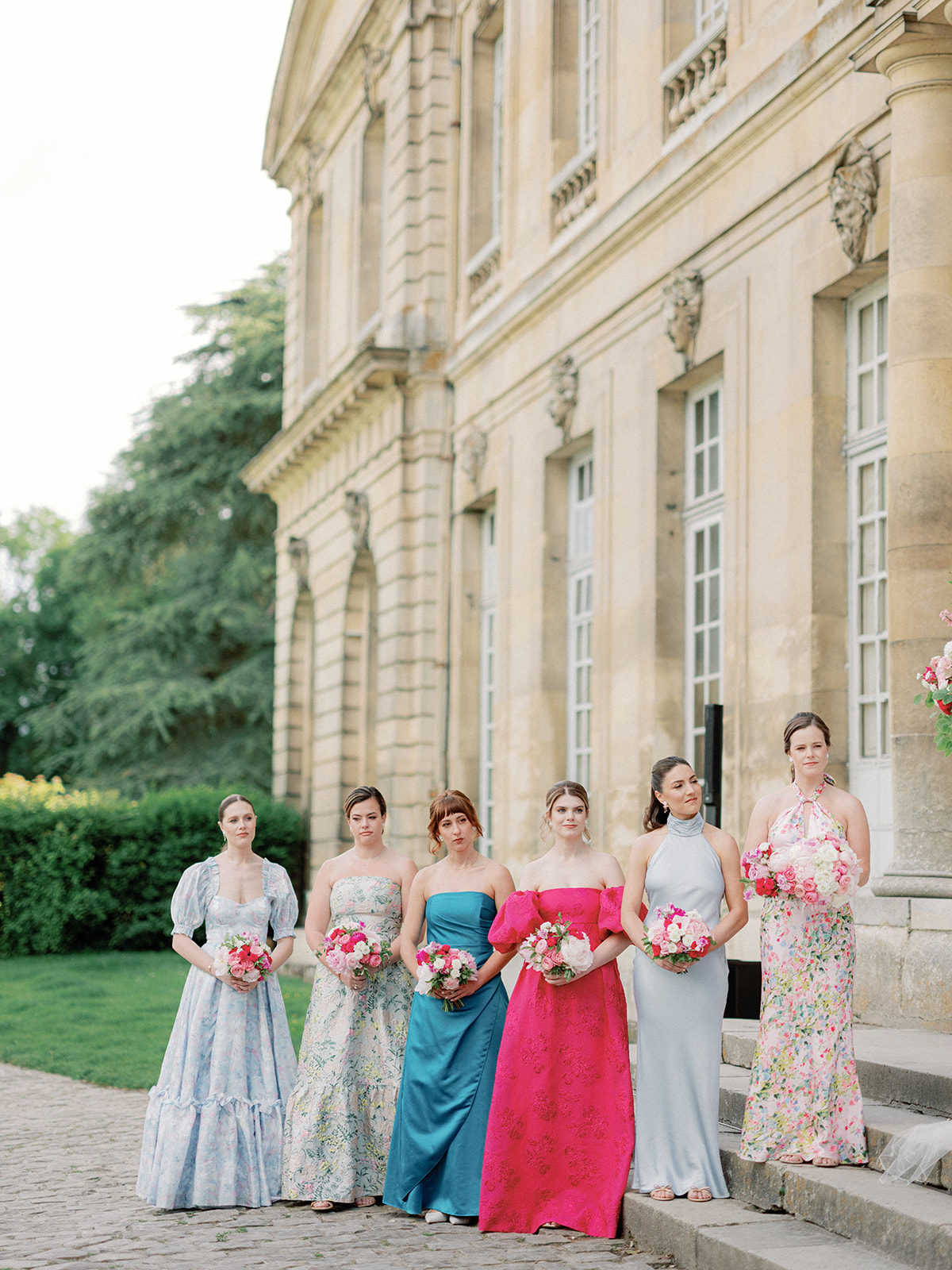
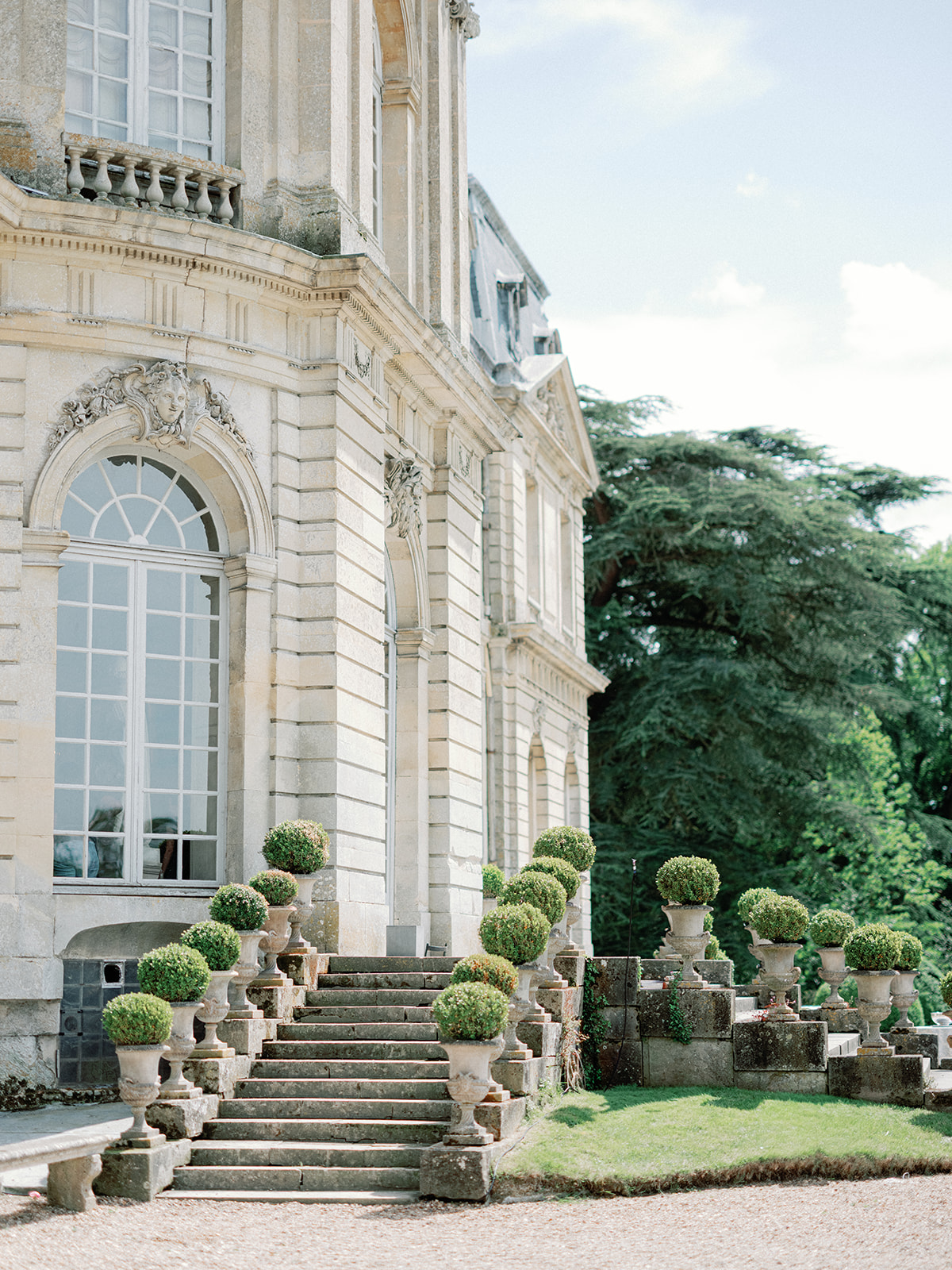
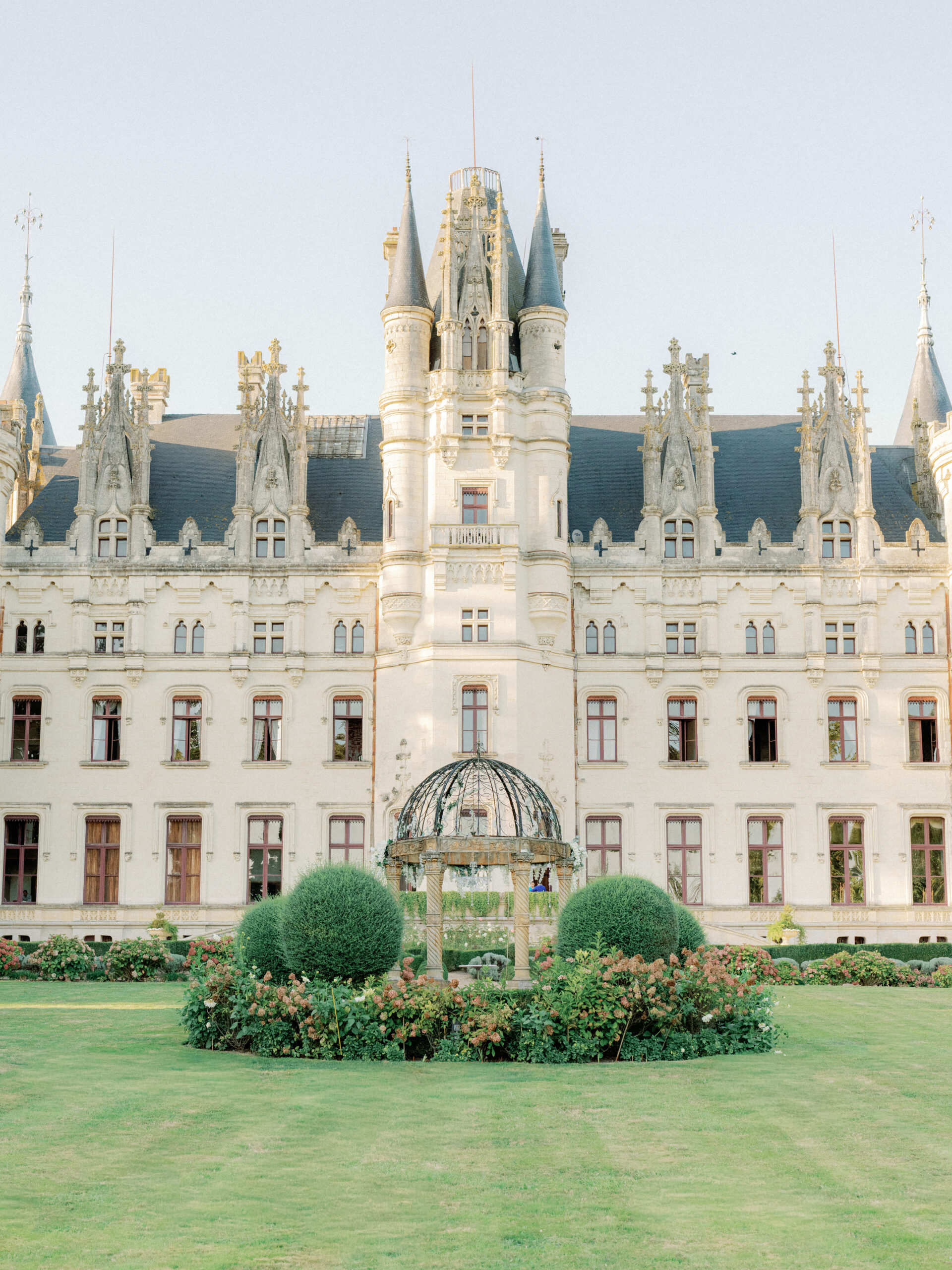
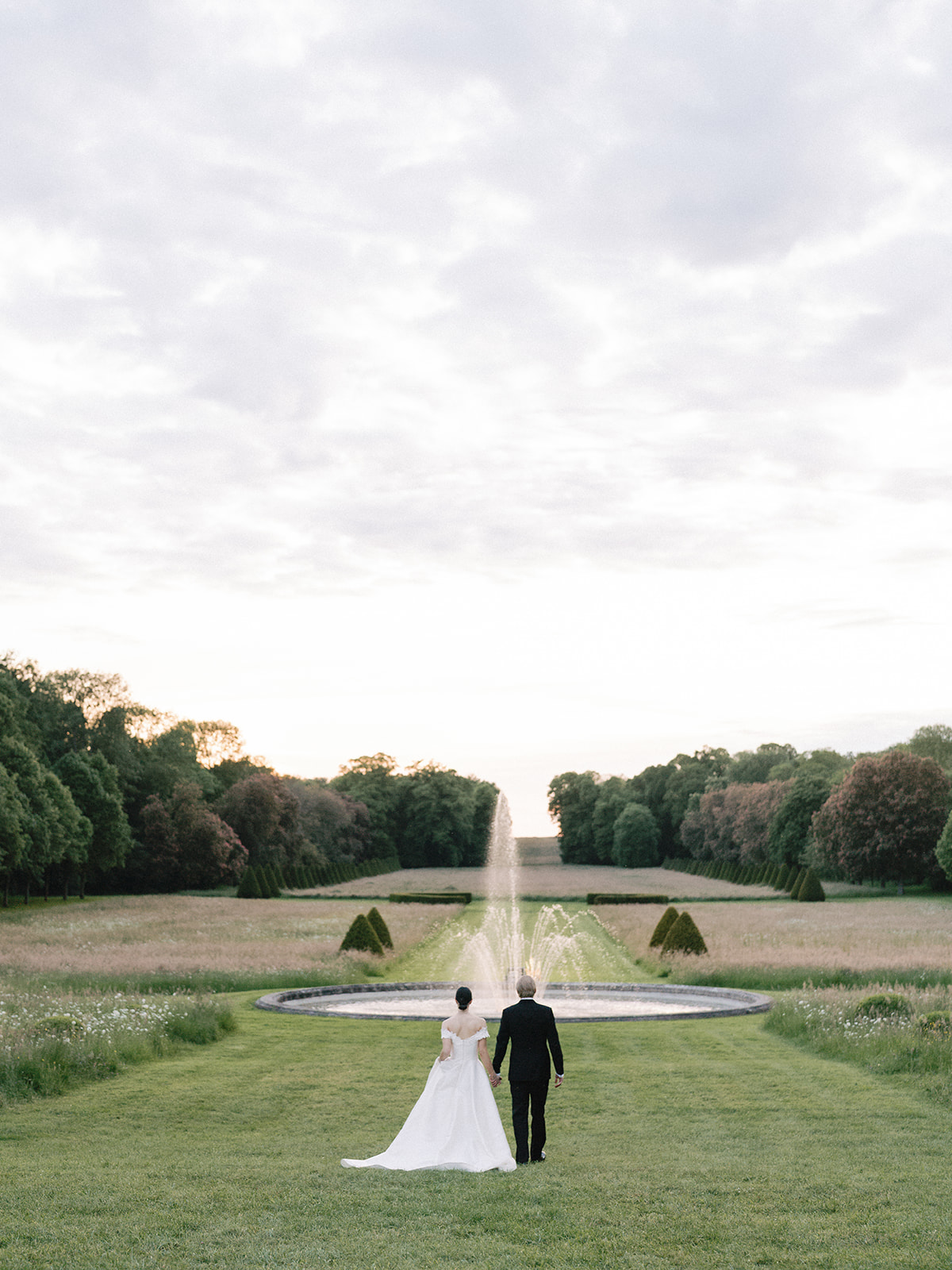
The third distinction is the view. The garden façade of Château de Champlâtreux — the side that faces the parkland and that most guests experience during cocktail hour and outdoor receptions — is one of the most purely beautiful architectural garden prospects I have encountered at any wedding venue anywhere in France. The symmetry of the building, the perron leading down to the lawn, the sweep of the park to the circular stone pond, and the centuries-old tree canopy framing the entire composition: these are the conditions that create images that look immediately and unmistakably like the most beautiful version of France that exists.
The Architecture: Room by Room
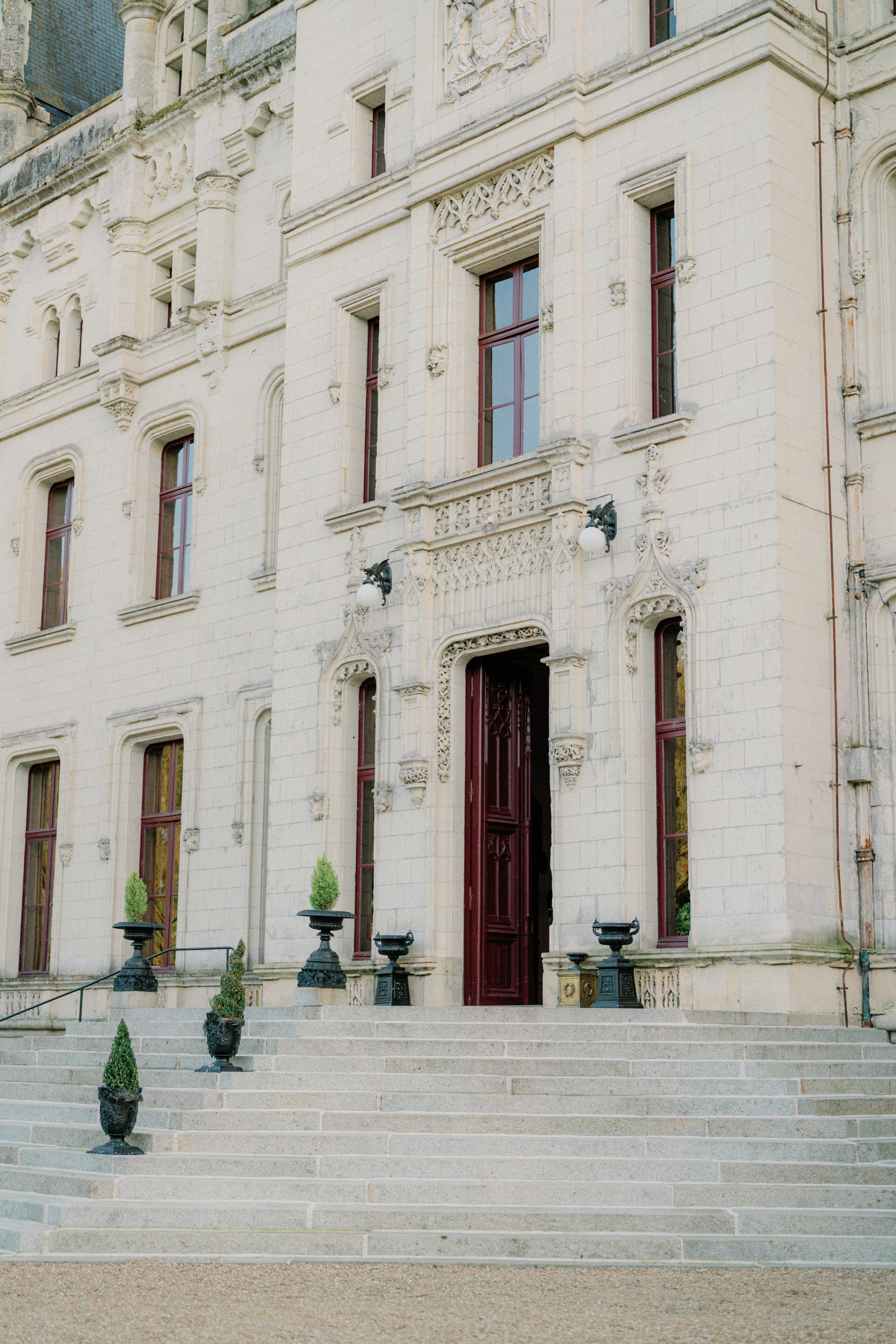
The approach to the château through the cour d’honneur — the formal courtyard entrance — sets the tone immediately. The arrival experience here is genuinely majestic. Guests stepping from their vehicles into the courtyard see the château’s principal façade ahead of them: symmetrical, composed, the stone warmed by whatever light the Île-de-France is providing on that particular afternoon. For photographers, the cour d’honneur is one of the strongest early-day locations on the entire property — arrival portraits, first-look moments between the couple and the building itself, and the formal architecture as a backdrop for any portrait that requires a classical French frame.
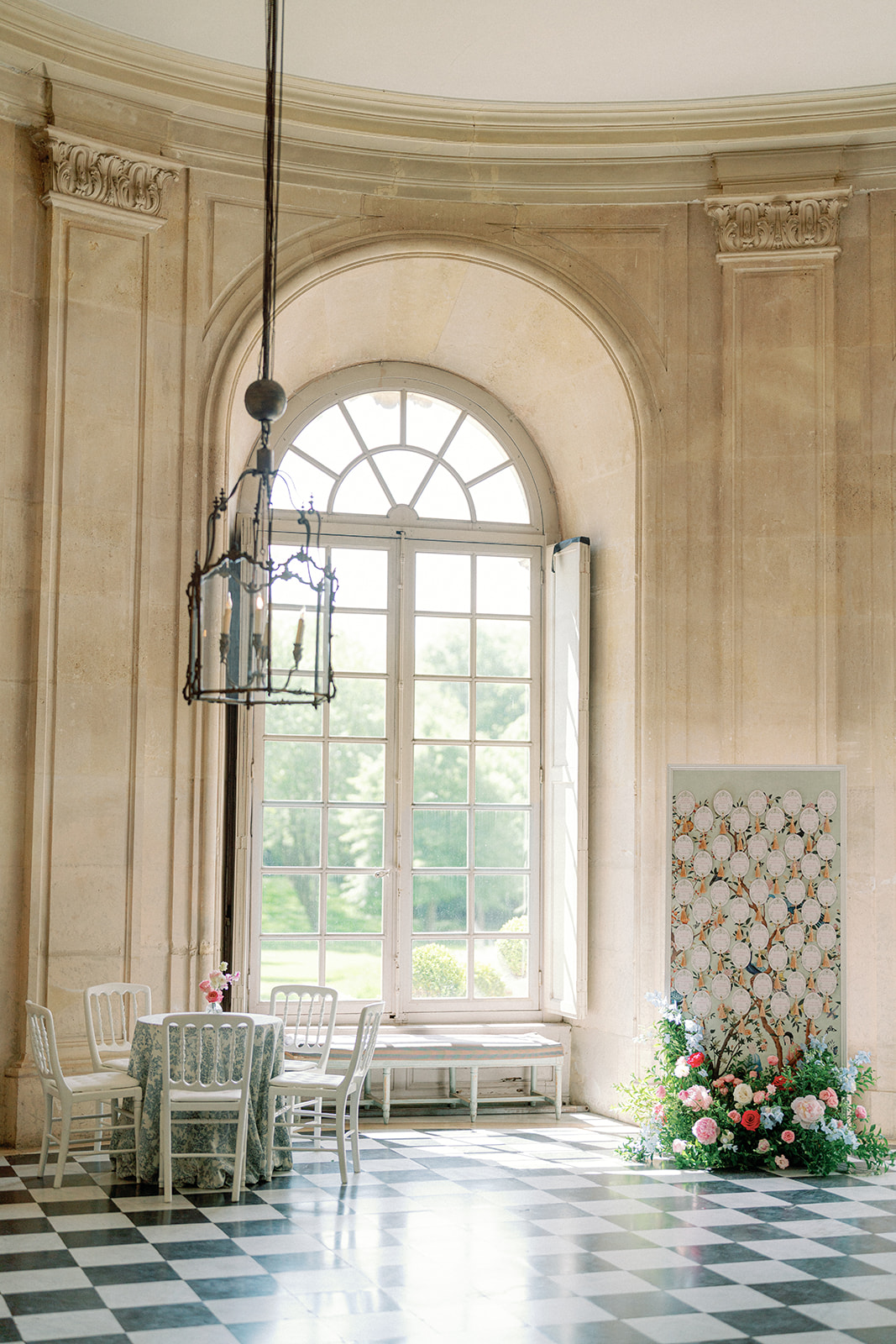
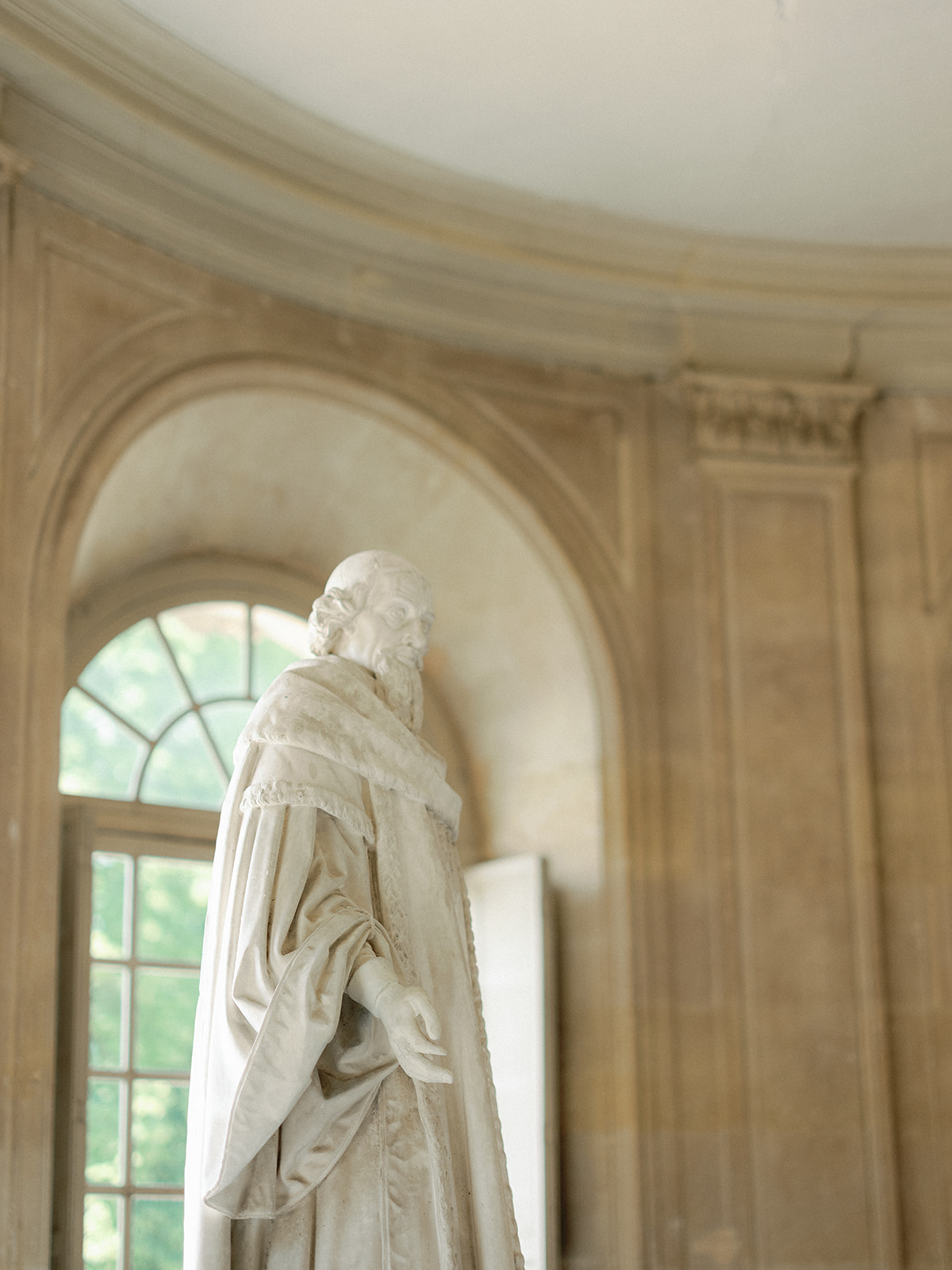
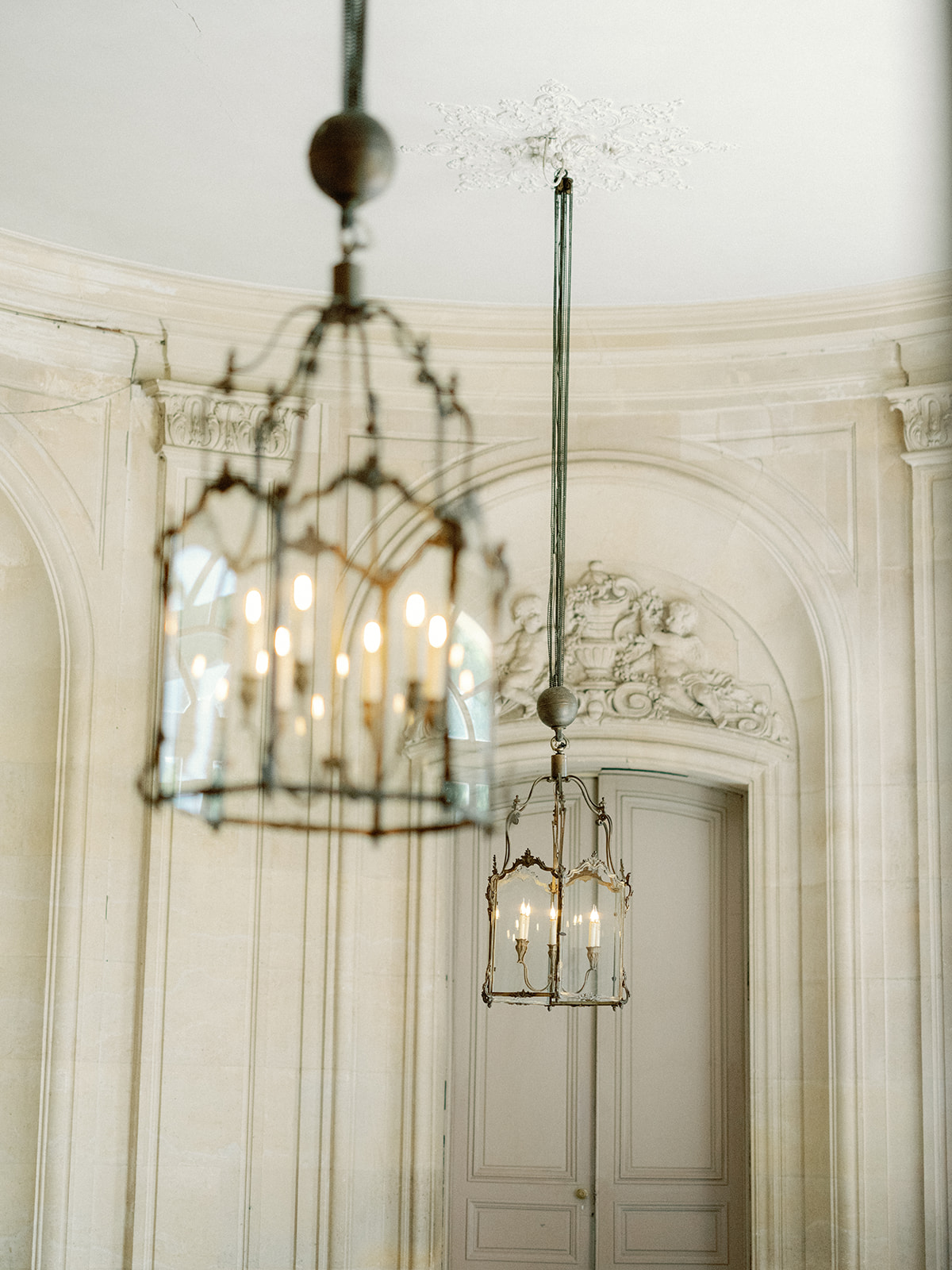

The marble and stone entrance hall — two vestibules comprising approximately 55 and 70 square meters — is the first interior the couple and their guests encounter, and it makes an immediate impression. The imposing columns, the marble-tiled floors, the stone walls that carry the light differently at different hours of the day, and the proportion of the spaces combine to create an entrance that makes everyone who walks through it feel that they are somewhere significant.
For photographers, the vestibule is a versatile environment — the interplay of stone, marble, column, and natural light from the tall windows produces portrait conditions that are very different from the warm paneling of the salons, and the variety within a short walk of each other is one of the practical gifts this building offers throughout the day.
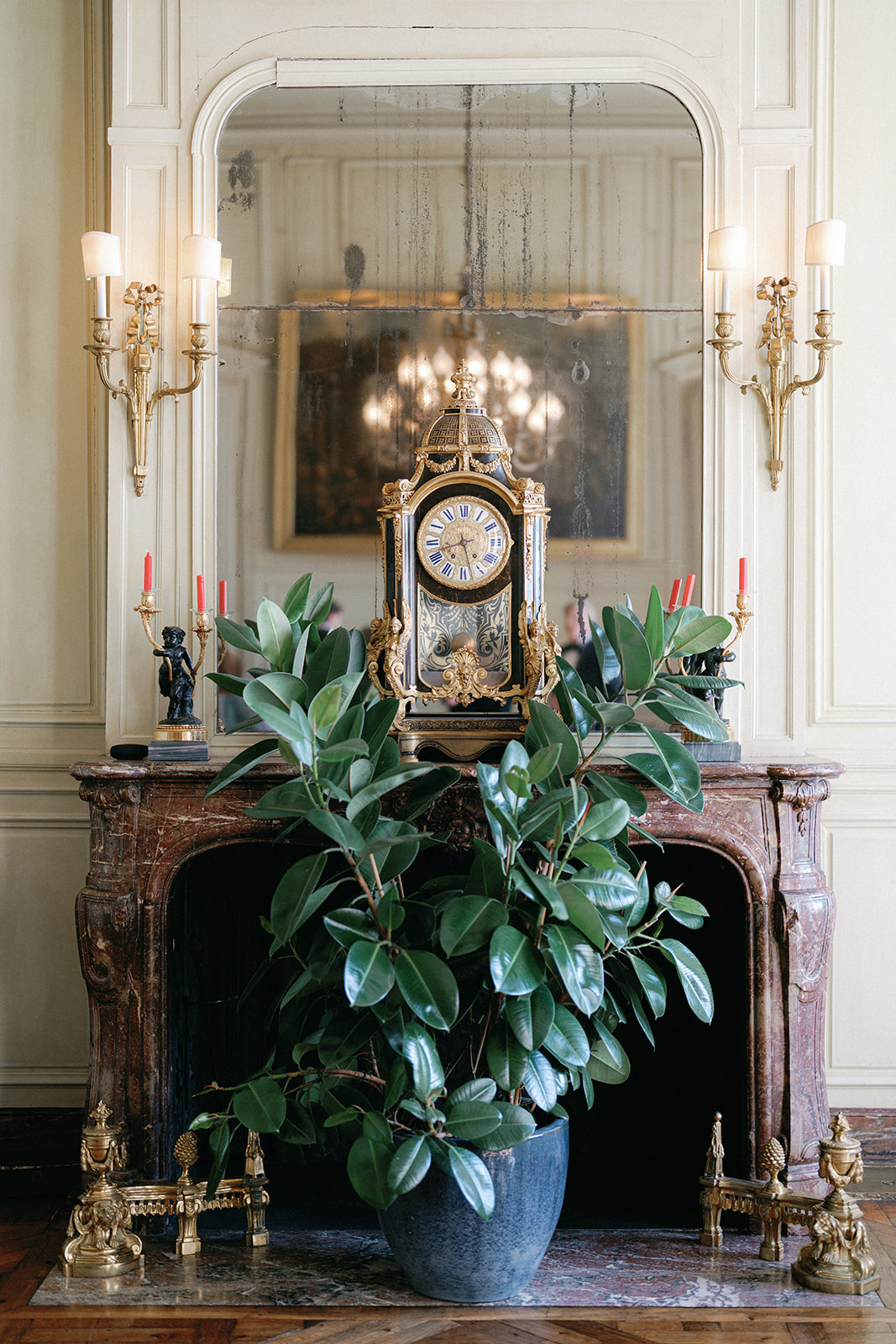
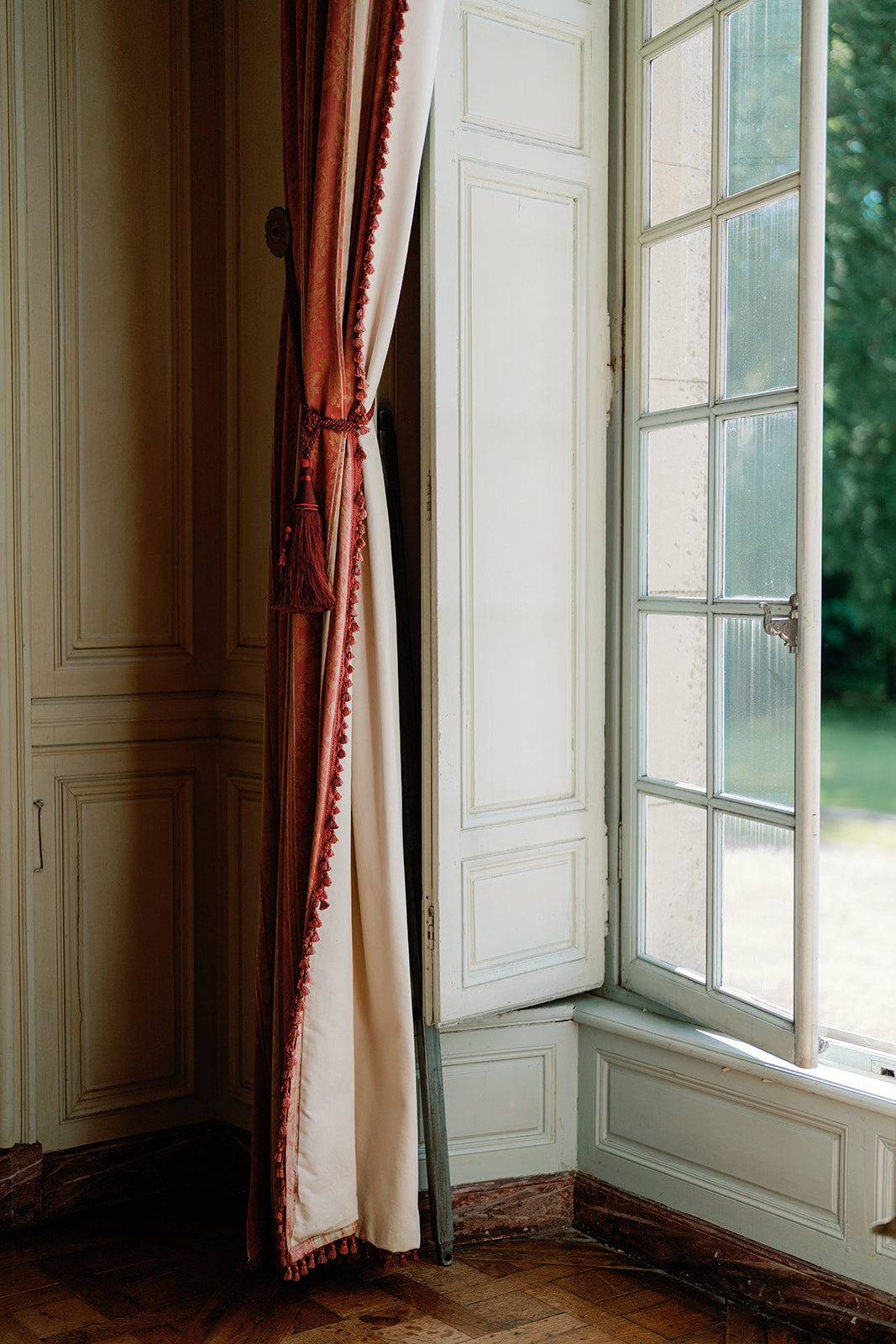
Beyond the vestibule, the four grand state salons open in succession — three of them en enfilade, meaning they interconnect without a corridor between them, creating a continuous flow of space that allows the 450 square meters of reception area to function as a single event environment or be divided into distinct zones for different phases of the celebration. Each salon has six-meter ceilings, Versailles parquet flooring, period woodwork and paneling, gilded mirrors positioned to catch and multiply the window light, and tall windows that frame the garden view in a way that makes the outside continuously present even when you are deep inside the building.
Le Grand Salon is the primary reception space — the room where dinners are held, where the dancing happens later in the evening, where the floral designers and lighting teams invest their greatest creative energy. It is a genuinely grand room, and the combination of the Versailles parquet, the gilded mirrors, the crystal chandeliers, and the tall windows overlooking the park produces interior photography that is as visually rich as any room I have worked in anywhere.
The afternoon light in Le Grand Salon between three and five o’clock, coming through the garden-facing windows at a low angle and landing on the parquet and the gilded surfaces, is the light I plan my portrait sessions around when I am shooting here in the warmer months.
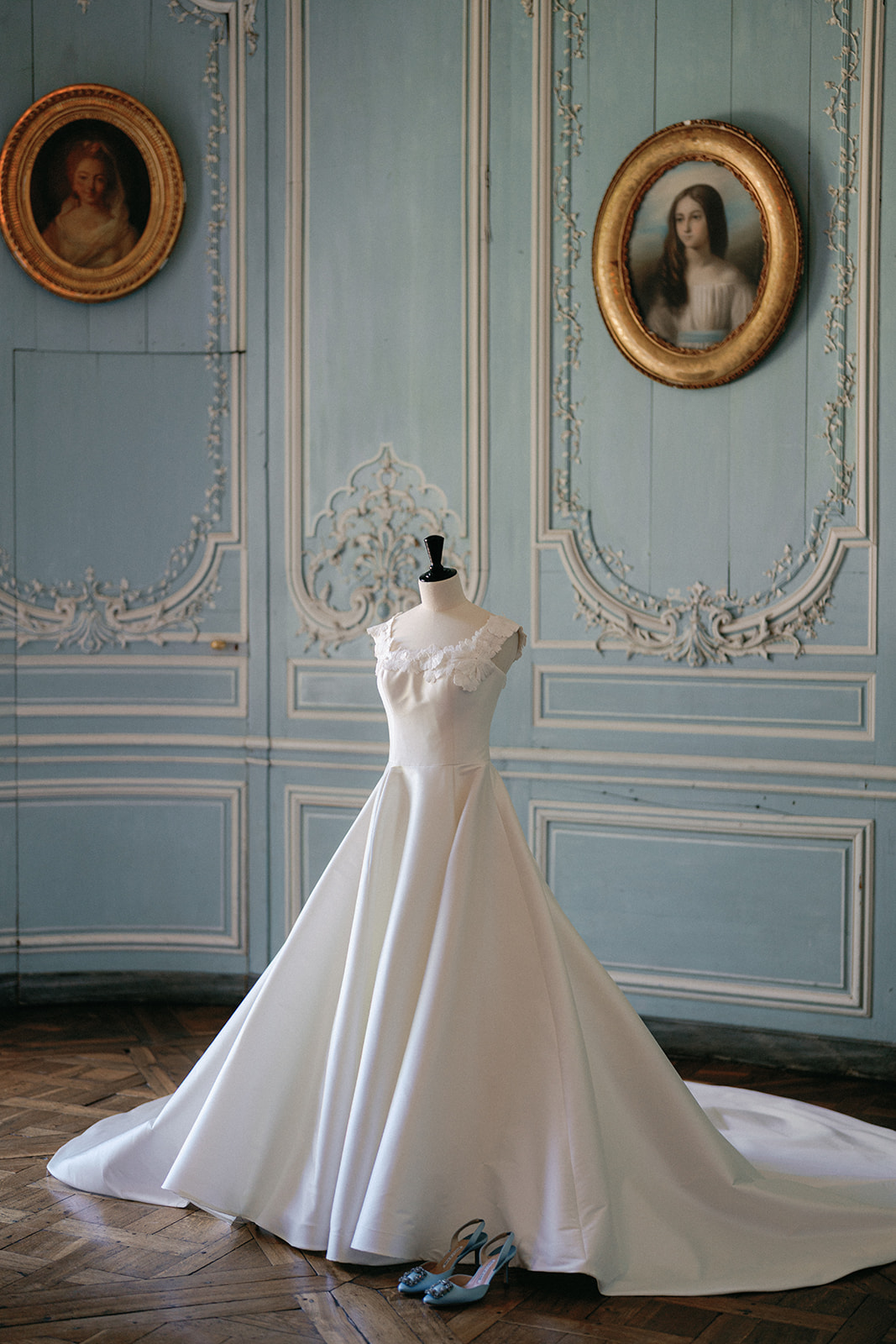
Le Salon Bleu — the Blue Room — has a character distinct from the Grand Salon: the signature Rococo boiseries in blue, the original period woodwork with its carved floral and foliate decoration, and a quality of light that is softer and more intimate than the principal salon. I use Le Salon Bleu consistently for bridal portraits during the getting-ready sequence, particularly in the later morning when the light through its windows is at its most flattering.
The room’s scale is right for a bride alone or with one or two members of her party — not overwhelming, not cramped, and with the architectural detail behind her doing significant photographic work without needing any additional decoration. This is my favorite room in the whole Chateau.
Le Salon du Billard has its own distinct atmosphere — a room that has absorbed decades of the particular quality of a space used for a specific, unhurried purpose. The Versailles parquet, the period furniture, and the windows flooding the space with natural light make it excellent for more informal portrait moments and for the kind of candid group shots that happen during cocktail hour when guests wander from room to room.
L’Antichambre — the fourth reception room — serves as the transitional space in the enfilade sequence. I find it useful for the in-between moments: the moments between ceremony and portraits, the gathering before dinner, the smaller conversations that happen at the edges of larger celebrations. It photographs beautifully as a space that connects the grander rooms to each other while having its own quieter character.
The Grand Escalier — the main staircase — is a six-foot-wide spiral of aged oak and wrought iron, with steps worn unevenly by centuries of use in a way that makes every image taken on it feel immediately historical rather than merely architectural. I use the staircase for first-look moments positioned on the landing, for bridal portraits descending toward the main floor, and for the kind of dramatic framing that requires a genuinely significant architectural element in the background. The staircase at Champlâtreux is not the overtly theatrical feature that some châteaux offer — it is more quietly elegant, and the images it produces reflect that quality.
The Grounds: 50 Hectares to Explore
If the interior of Château de Champlâtreux is the reason couples book this venue, the grounds are often what they talk about most afterward. The 50-hectare park — a combination of French formal garden remnants visible in the mature cypress tree alignments, and the 1823 English-style landscape park designed by the Thouin brothers — provides an extraordinary range of photographic environments within a single property.
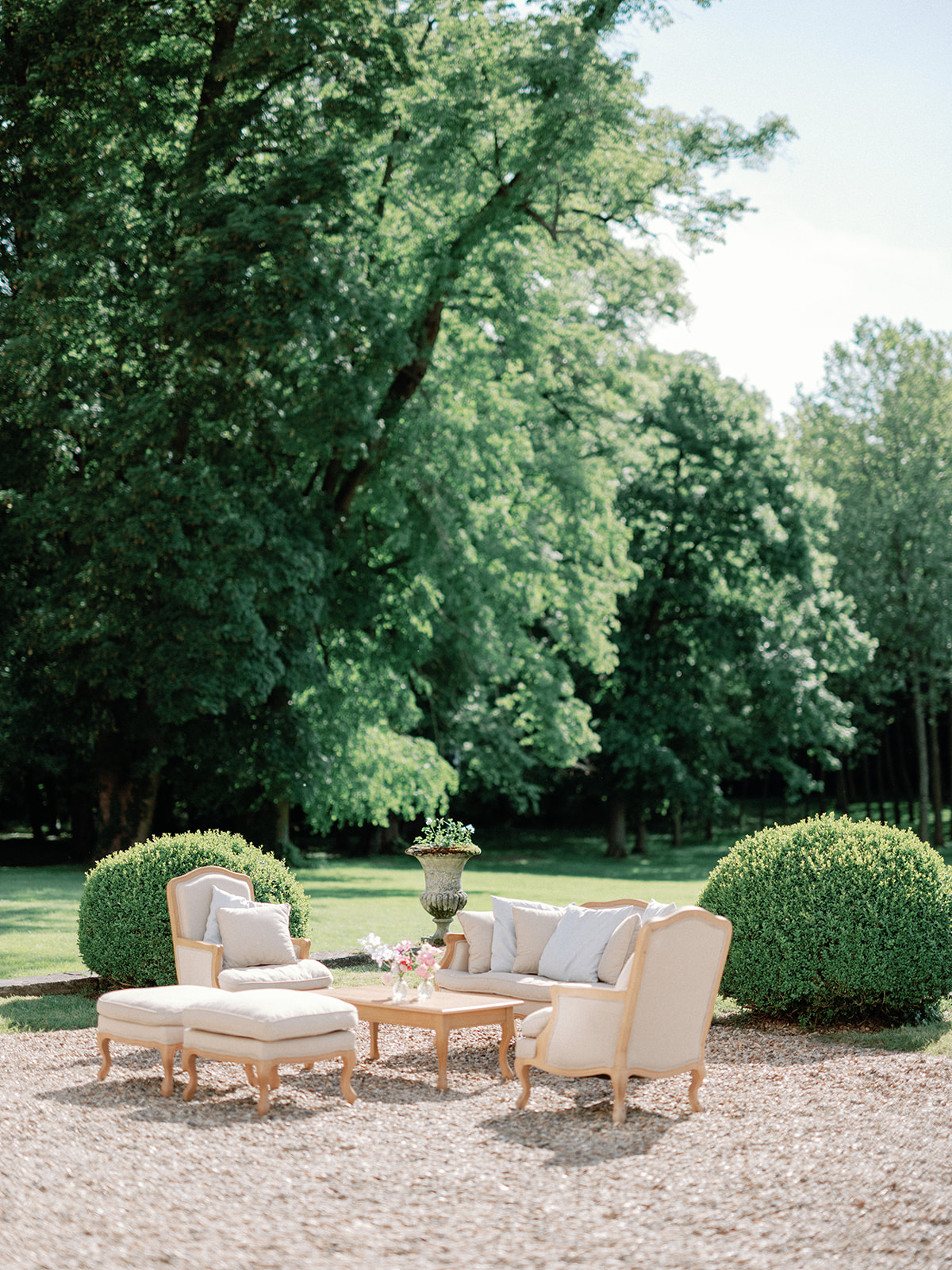
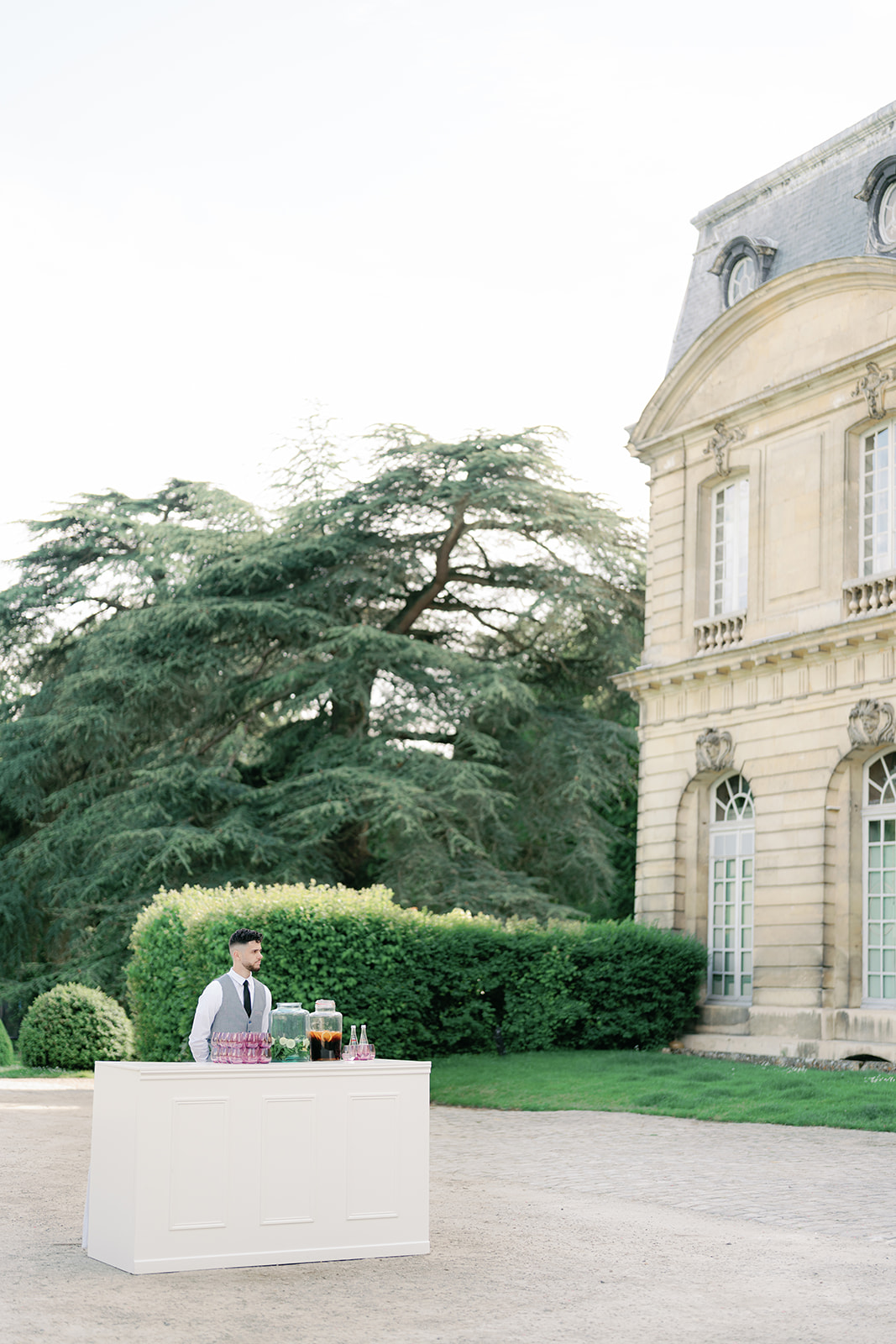
The garden terrace immediately behind the château is where the cocktail hour most naturally unfolds. The combination of the château’s garden façade behind the guests, the terrace underfoot, and the park stretching ahead — with the circular stone ornamental pond as the central focal point of the view — creates a scene that works as ambient photography and as formal portrait setting simultaneously. In the warm months, when the park is at its most lush and the evening light is beginning to soften, the cocktail hour terrace at Champlâtreux produces some of my most consistently beautiful ambient images of any wedding day.
The circular pond is my preferred portrait location for the late-afternoon golden hour session. The reflection of the sky and the distant tree canopy in the still water, the couple positioned on the path between the château and the pond with the building visible behind them, and the quality of the light at this hour on the Île-de-France countryside — warm, amber, long-shadowed — create portrait conditions that are genuinely exceptional. I plan my timeline specifically around this session when I am working at Champlâtreux, and it consistently produces the images that couples most want printed large.
The centuries-old trees throughout the parkland create dappled light environments that are useful throughout the day for more intimate portraits — the kind of images that feel removed from the formality of the château’s architecture while still very much within the property’s atmosphere. The mature tree canopy in summer filters the harsher midday light into something softer and more directional, making the parkland a useful refuge during the hours when direct sunlight would otherwise be challenging.
The historic stables are a photographic environment that I use differently at different weddings depending on the couple’s aesthetic. The U-shaped brick and stone courtyard, the 18th-century carved wooden stalls visible through the stable doors, the antique drinking troughs and the coach house — together they create a setting that is explicitly historical and explicitly French in a way that complements the château’s more formal grandeur rather than competing with it. For couples whose aesthetic has a more rustic or editorial edge, the stables provide a contrast to the salon interiors that gives the day’s portfolio a wider visual range.
The 18th-century Saint-Eutrope Chapel, set within the estate’s grounds, is one of the most significant ceremony options the property offers. A genuinely beautiful small chapel from the same era as the château, it provides a consecrated space for couples who want a religious or chapel ceremony within the estate rather than in a village church. As a photography location, the chapel exterior and the procession to and from it produce images that are specific and irreplaceable — the scale of the building relative to the participants, the stone and the sky, the ceremony arriving at a chapel that was built when the château was new.
The Ceremony: Where to Say Your Vows
One of the things I most appreciate about Château de Champlâtreux as a wedding venue is the genuine range of ceremony options it offers, each with its own distinct character and each suited to a different vision and guest count.
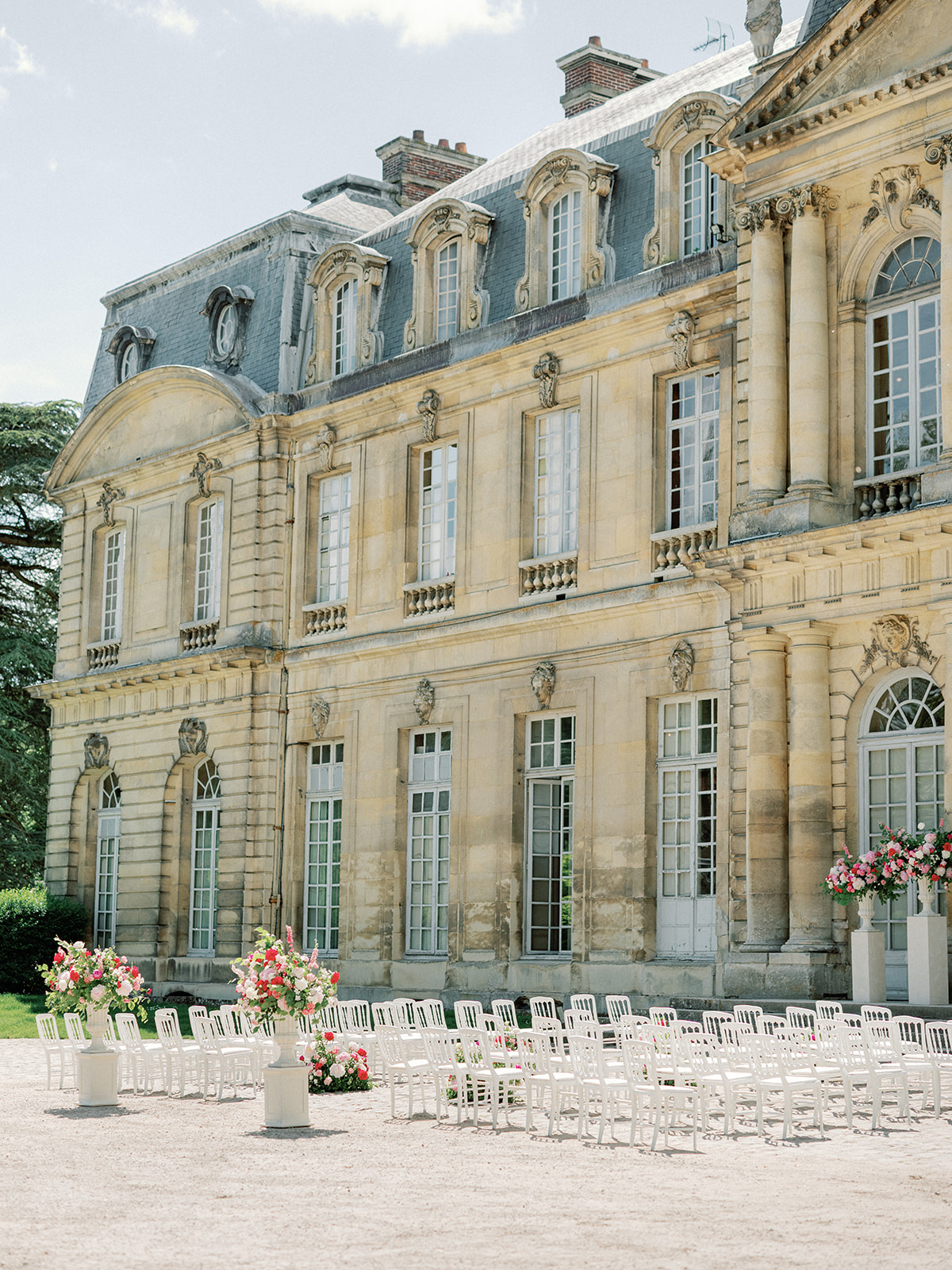
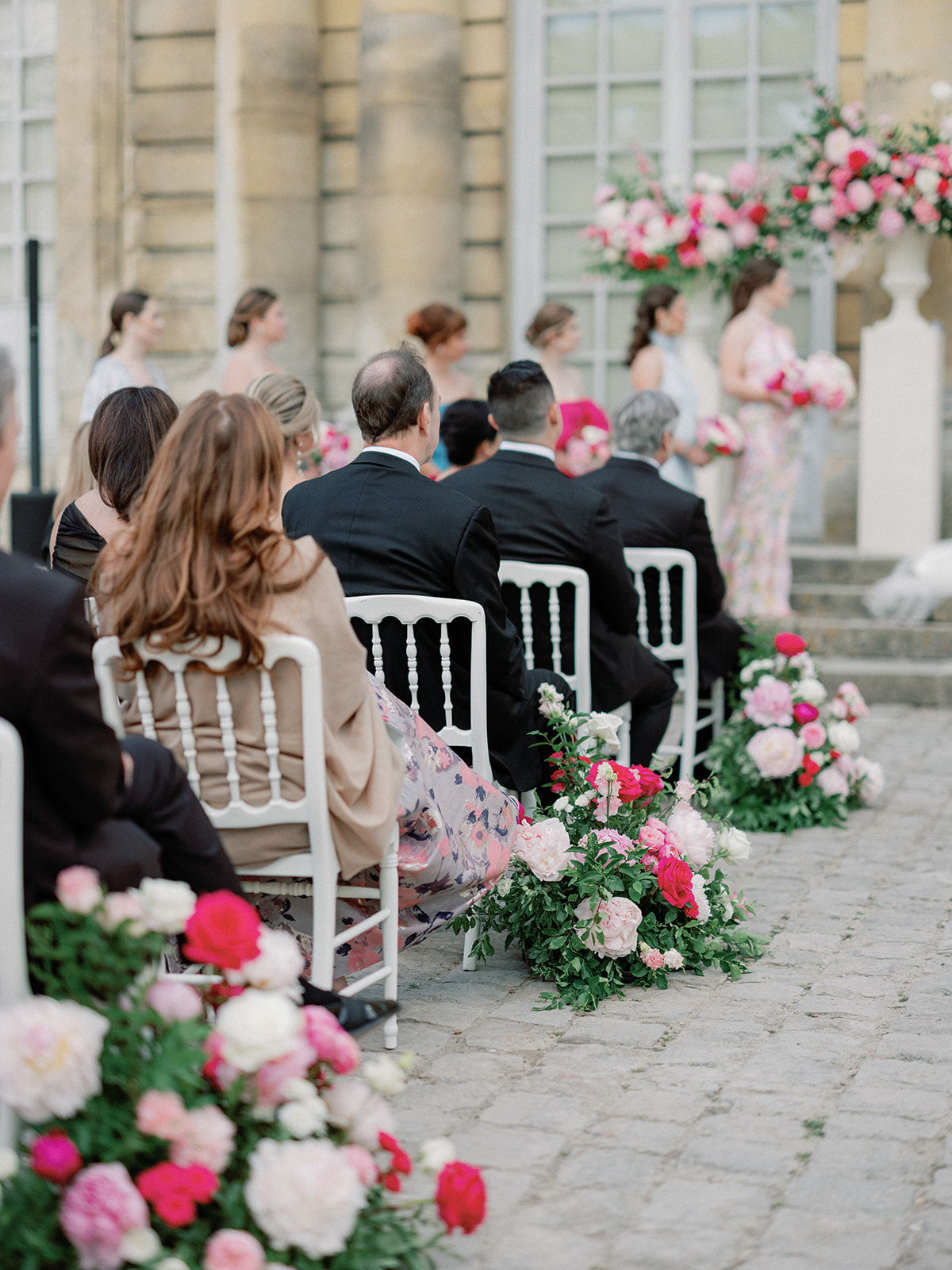
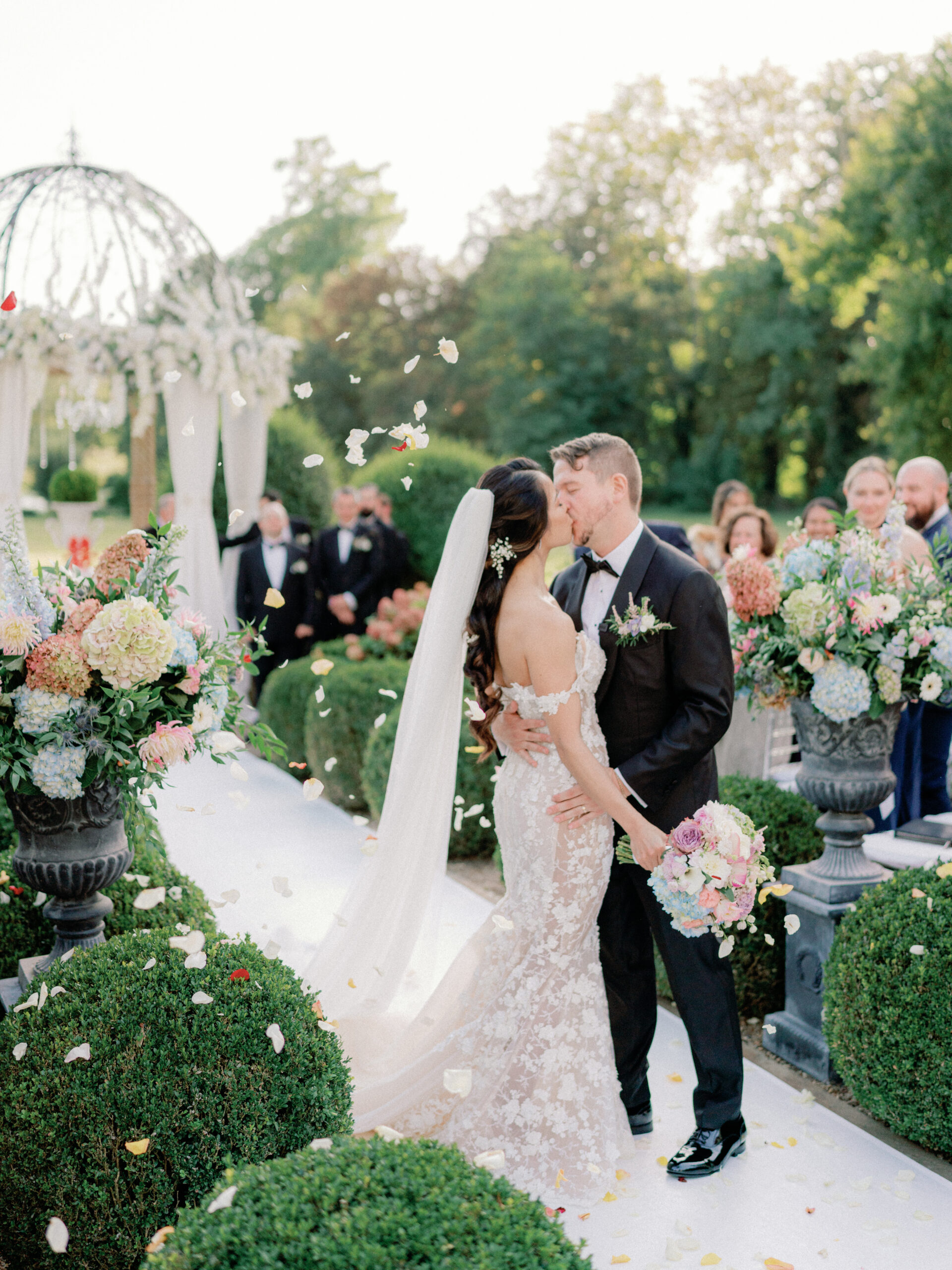
The outdoor ceremony beneath the centuries-old trees on the garden side of the château is the option I most frequently recommend for couples marrying in the warmer months. The combination of the château’s garden façade as the backdrop, the park’s mature tree canopy providing natural shade and filtered light for guests, and the sweeping lawn as the ceremony space creates an environment that is beautiful from the guests’ perspective — they are seated facing the couple with the building behind them — and photographically extraordinary from mine. The scale of the trees relative to the couple and their guests produces images that convey the meaning of the occasion through the setting’s authority rather than through elaborately designed décor.
The Vestibule serves as the indoor ceremony space — and it is a more compelling option than the description might suggest. The imposing columns, the marble floors, the quality of the light through the tall windows, and the six-meter stone walls create a ceremony environment of genuine grandeur.
I have photographed indoor ceremonies at Champlâtreux when the weather necessitated moving inside, and the resulting images do not feel like a weather contingency. They feel like a deliberate choice that turned out to be the right one. One wedding planner I worked with here made the point that hosting the ceremony indoors actually concentrates the décor — what the vastness of the grounds can dilute, the scale of the Vestibule holds and amplifies.
When the ceremony is held indoors, the adjacent salon is immediately available for the cocktail hour while the team transforms the ceremony space for dinner — a practical advantage that the building’s enfilade layout makes genuinely efficient.
The Saint-Eutrope Chapel within the grounds is the third option — available for both religious and symbolic ceremonies, capable of being decorated to the couple’s taste, and offering a ceremony experience that is specific to this estate and to this era of French architecture.
Getting Ready: The Closerie and Le Salon Bleu
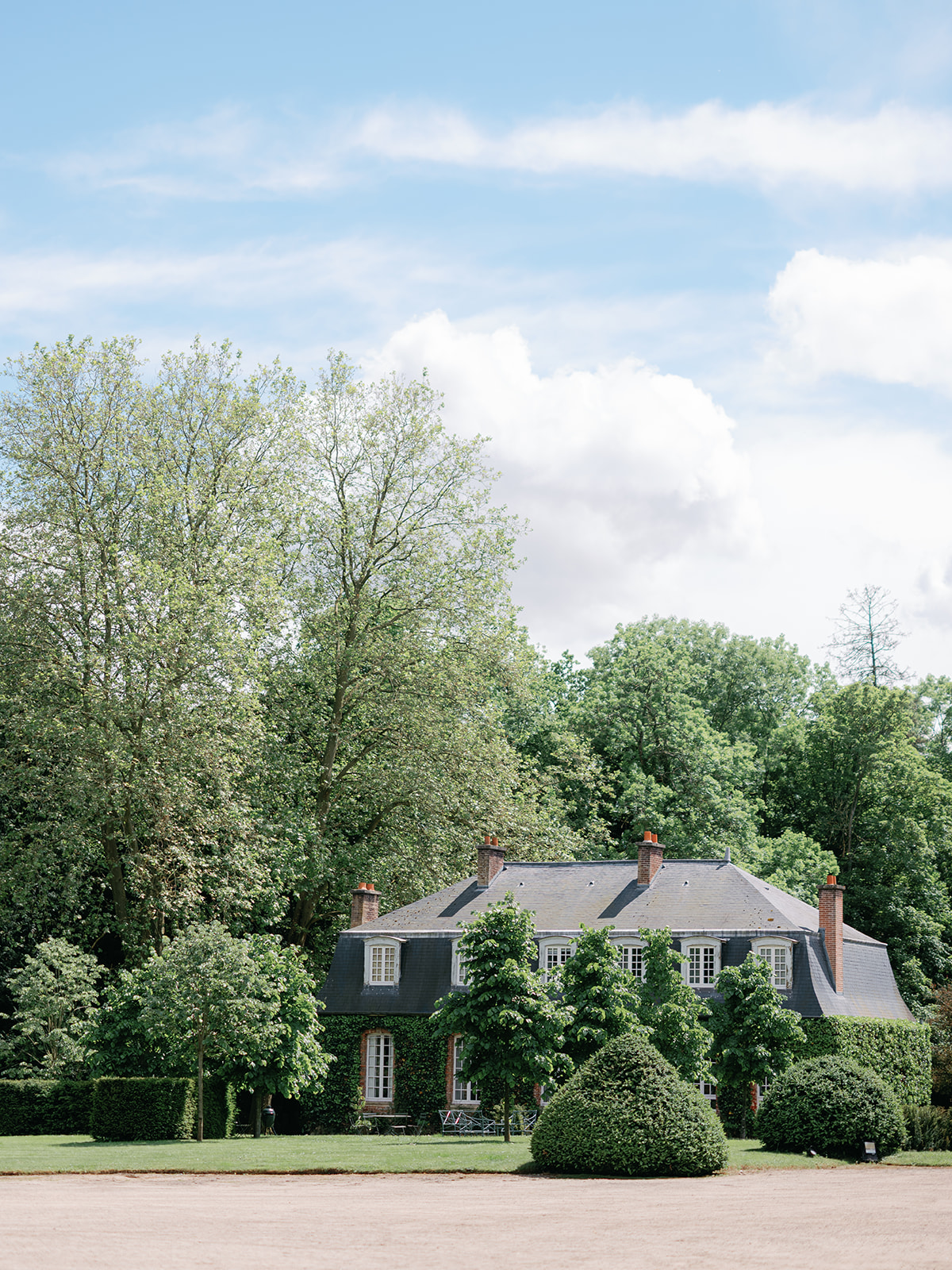
The on-site accommodation at Château de Champlâtreux is the Closerie — a charming 170-square-meter guesthouse set within a 2,000-square-meter private garden, approximately two minutes’ walk from the château. The Closerie sleeps up to 12 guests and is included as a two-night stay in the venue rental. It serves as the bridal preparation space — a genuinely comfortable private house with its own garden where the bride and her closest people can begin the day with a sense of unhurried calm before crossing the park to the château.
The Closerie’s character is different from the château’s formal grandeur: warmer, more domestic, with the quality of a well-loved garden cottage. Getting-ready photographs here have a quality of intimacy and ease that sets them apart from the more architectural images the château’s salons produce — a useful contrast that gives the day’s portrait sequence a wider emotional range.
Within the château, Le Salon Bleu is the room I most consistently use for bridal preparation portraits — the Rococo boiseries, the period scale, and the morning light that reaches it combine to create conditions for bridal portraits that are among the most beautiful available at any venue in the Île-de-France region. When I am at Champlâtreux, I plan time in Le Salon Bleu during the getting-ready sequence specifically for this reason.
The Reception: How the Celebration Unfolds
A wedding at Château de Champlâtreux unfolds across multiple environments with a natural progression that the building’s organization supports almost without effort. The cocktail hour on the garden terrace, with guests dispersed across the lawn and along the path toward the pond, the château behind them and the park ahead, represents the most distinctly French hospitality experience of any phase of the day — a gathering on a private estate in the Île-de-France countryside that could not plausibly happen anywhere else.
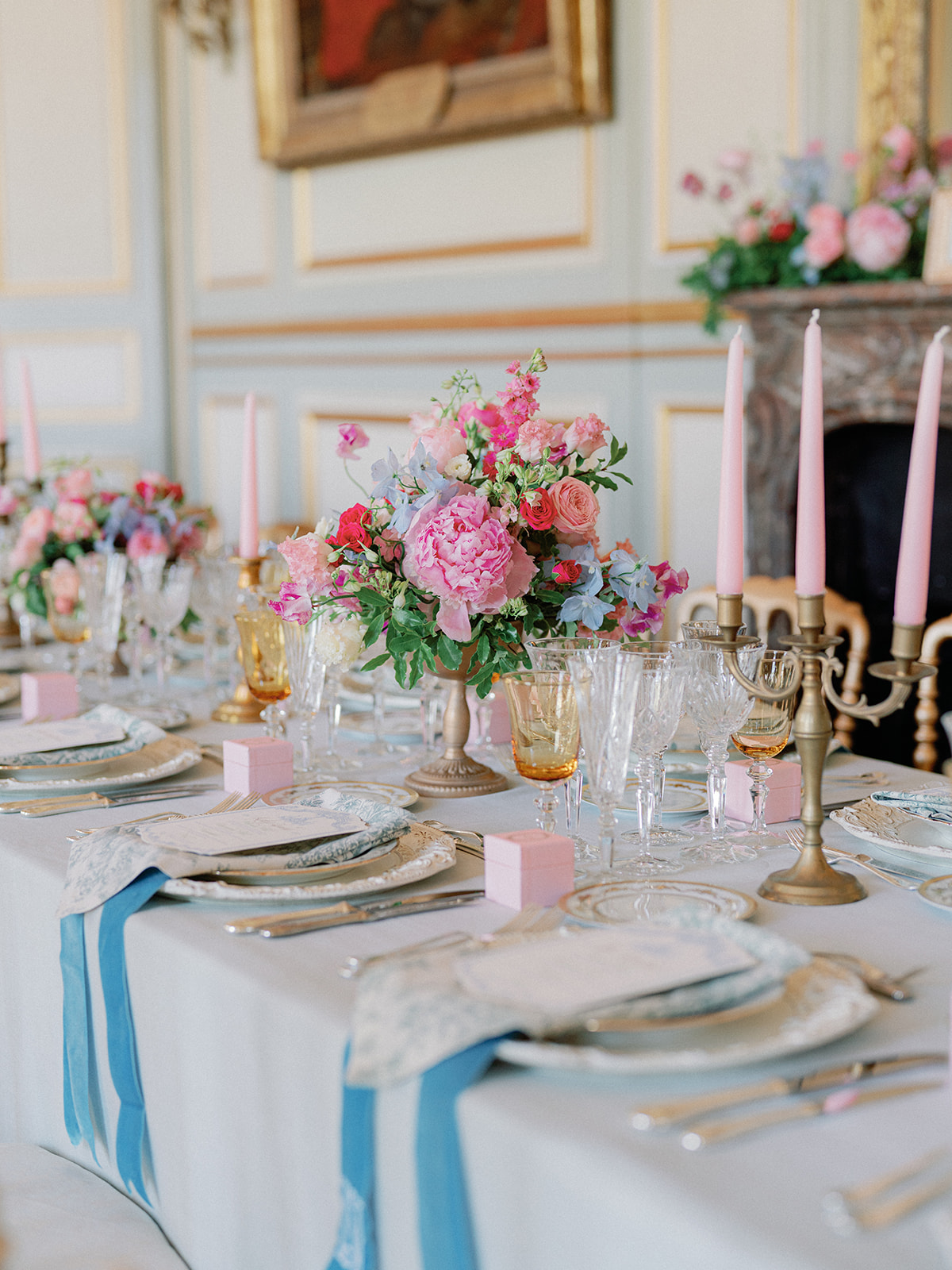
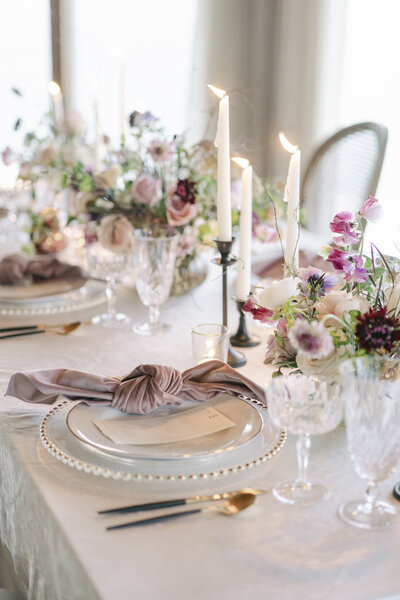
The dinner in Le Grand Salon or across the enfilade of salons is where the quality of the building’s interior is most fully experienced. Tables set with ivory linens, crystal, and gold flatware on Versailles parquet under gilded mirrors and crystal chandeliers — illuminated in the evening by candlelight and the outdoor lighting of the park beyond the tall windows — create a dining environment that is simultaneously the most formal and the most immediately warm. I have photographed the moment when the groom first sees the dinner room set up and illuminated for the evening, and that particular expression — the involuntary pause, the full stop of surprise — happens at Champlâtreux more reliably than at almost any other venue I know.
The dancing moves between the Grand Salon and the Salon du Billard as the evening progresses, with the enfilade layout allowing guests to move between dancing, conversation, and the cool air of the terrace without any of it feeling segregated or managed. Events run until 3:30 AM, with the château accessible until 6:00 AM — late enough for any celebration to reach its natural conclusion.
Fireworks can be arranged over the park — and the view of fireworks from the garden terrace, with the château illuminated behind and the parkland absorbing the reflected light, is one of those wedding moments that guests describe for years. The pyrotechnics team works with the venue’s event coordinator to position the display in relation to the pond, so the reflection doubles the visual effect and the images produced are genuinely spectacular.
Practical Details: Pricing, Capacity, and Logistics
Château de Champlâtreux is a dry-hire venue. This means the estate provides the building, the grounds, the event coordinator, and the infrastructure — the couple brings in all catering, florals, entertainment, and other vendors independently. This structure gives couples with specific visions complete freedom to build the event exactly as they imagine it, without working around an in-house caterer’s menu or a house photographer’s aesthetic. A preferred caterer list is provided in the venue’s brochure; hiring outside this list is permitted at a higher rate.
Venue fees range from approximately €8,990 to €12,940 depending on the season and whether a partner catering company is engaged. The rental includes exclusive use of the château’s salons and parkland, access from 9:00 AM to 6:00 AM the following day, outdoor lighting of the grounds and the château’s façade, a dedicated event coordinator, on-site parking for up to 160 vehicles, and the two-night stay at the Closerie for up to 12 guests.
Capacity reaches 500 guests for cocktail receptions and 300 for seated dinners across the indoor salons and outdoor spaces. The venue can accommodate configurations from an intimate dinner of 40 in a single salon to a full-scale reception of 300 in the combined enfilade and outdoor areas. The flexibility of the enfilade layout — the three interconnecting salons — allows the event to scale to the guest count rather than requiring couples to fill a space designed for twice their party.
Optional extras available through the venue include a 1985 Rolls Royce Corniche for arrival photography, a Porsche 911, or a vintage Mustang — each offering a different character for the arrival or departure imagery. The venue’s event team collaborates with a network of technical partners for live music, lighting design, and pyrotechnics, and the coordinator’s experience with the property means that vendor arrivals, setup logistics, and day-of timing are managed with the precision that a historic monument requires.
Getting There
Château de Champlâtreux is located at D316, 95270 Épinay-Champlâtreux, Val-d’Oise, approximately 27 kilometers north of central Paris. By car from Paris city center, the journey takes approximately 30 minutes under normal traffic conditions. From Charles de Gaulle Airport, the drive is 15 minutes — a detail that makes the venue uniquely accessible for international guests arriving by air.
From London, the route runs Eurostar to Paris Gare du Nord, followed by a 30-minute transfer to the château by car — approximately three and a half hours door to door in total, a perfectly manageable journey for a weekend destination wedding. From other European cities, the combination of Charles de Gaulle’s direct flight connections and the 15-minute drive to the venue makes Champlâtreux one of the most accessible grand château venues in all of France.
The château’s event team can organize transportation for the couple and their guests from Paris, CDG, and surrounding areas, which simplifies the logistics considerably for couples who are not familiar with arranging ground transport in the Île-de-France.
The Best Seasons for a Château de Champlâtreux Wedding
Having photographed here across multiple seasons, I want to share specific observations about what each time of year offers at this venue, because the differences genuinely matter for couples who care about the character of their photographs.
Late spring — May and early June — is when the parkland is at its most vibrantly green and the flower beds visible from the salon windows are at their most abundant. The evenings are long and the light remains directional and warm until well past 8:00 PM, which gives the cocktail hour and the early reception a quality of golden garden light that is specific to this latitude and this season. The Île-de-France countryside in May is a different visual register from any other month, and the château’s pale limestone responds to that light particularly well.
Summer — June through September — is the peak of the peak for reason that are immediately apparent when you photograph here in this season. The light on a clear July afternoon, coming through the tall garden-facing windows of Le Grand Salon at the right angle, turns the Versailles parquet and the gilded surfaces into something that I find genuinely extraordinary to work with. Summer evenings at Champlâtreux, with the park illuminated and the fireworks reflecting in the circular pond and the château lit against the dark Île-de-France sky, produce images that require very little beyond being in the right place at the right moment.
Autumn — September through October — is the season I find most compelling for portrait work at this specific property. The quality of the light in October in the Île-de-France is lower-angled and warmer than in summer, and the effect of that light on the château’s pale stone, on the circular pond’s reflection, and on the maturing tree canopy of the parkland is something I find endlessly productive as a photographer. The golden hour in October here extends across a longer window than in summer and the color temperature is richer — the images from this season have a depth and warmth that the flatter summer light, however beautiful, does not quite achieve.
Winter pricing runs through the quieter months and represents meaningful savings relative to the summer tariff — a relevant consideration for couples whose dates are flexible and who want to allocate more of their budget toward the catering, floral, and entertainment experience rather than the venue rental itself. The château in winter, with the park in its more austere palette and the salons illuminated entirely by candlelight and chandelier, has its own completely different beauty — more intimate, more cinematic, very French in the specific way that French things are French in winter.
What I Tell Every Couple Who Asks About Château de Champlâtreux
After photographing weddings at a significant number of the most celebrated château venues in France, the question I am most often asked is how Champlâtreux compares — what it is that makes this particular property worth the planning effort of a destination wedding in the Île-de-France countryside.
My answer is always the same, and it comes down to two things that cannot be manufactured or replicated.
The first is the location. No other estate of this architectural quality in the Île-de-France combines proximity to Paris, proximity to Charles de Gaulle, and genuine grand château character with the seclusion of a 50-hectare private park. Champlâtreux allows couples to give their guests a Paris destination experience — a city many of them want to visit — while celebrating in a setting that is completely removed from the city’s energy. The combination is logistically seamless and experientially extraordinary.
The second is the specific quality of the building itself. Château de Champlâtreux was designed by one of the leading architects of 18th-century France for a client who spared nothing in its construction. The four salons, the marble vestibules, the Versailles parquet, the gilded mirrors, the six-meter ceilings — these are not decorative choices applied to a converted barn or a renovated hotel. They are original features of a building that has been in continuous use for 270 years and that carries that continuity in every surface and proportion. When I photograph a wedding here, I am working in spaces that were designed for exactly what I am photographing, and the images reflect that alignment.
For couples planning a destination wedding and weighing France against other European options — who want Paris as part of the story but want their ceremony to happen somewhere that Paris itself cannot provide — Château de Champlâtreux is the venue I recommend above nearly everything else in this region of France.
If you are considering Château de Champlâtreux for your wedding and want to talk about what your day might look like — what the light is doing at which hour, which rooms work best for different moments, how to build a timeline that captures everything this extraordinary property has to offer — I would be genuinely honored to be part of that conversation. Reach out through my contact page and let’s talk about your vision.
Venue: Château de Champlâtreux, Île-de-France, France
Venue Fees: €8,990 to €12,940 depending on season and catering arrangement



add a comment
+ COMMENTS