



The Natural History Museum of Utah: Salt Lake City’s Most Architecturally Extraordinary Wedding Venue at the Natural History Museum of Utah
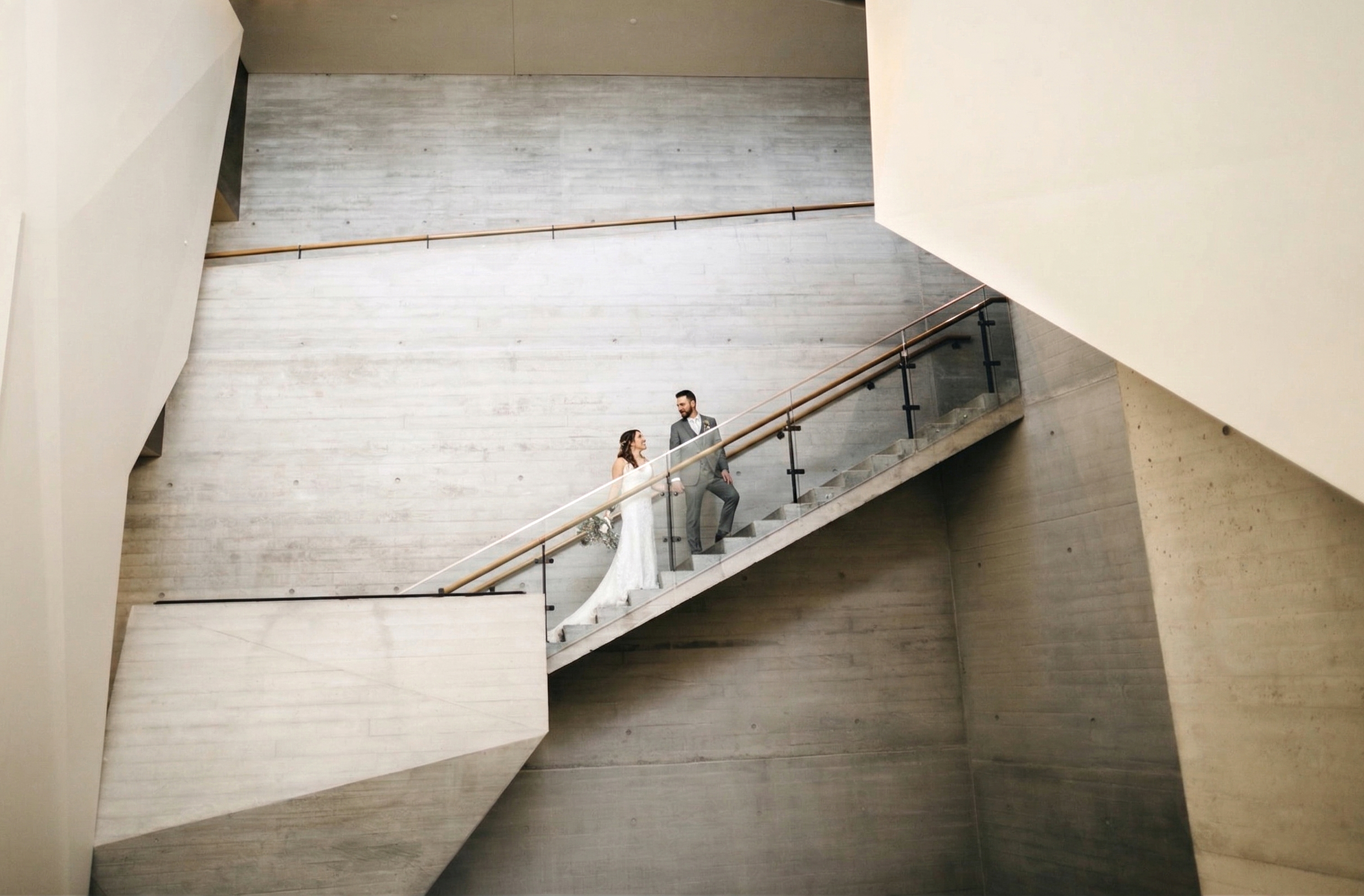
There is a moment when you walk into the Canyon at the Natural History Museum of Utah — that soaring, sixty-foot-high central atrium at the heart of the Rio Tinto Center — where something happens that I have watched repeat itself with every couple and every guest who enters the building for the first time. They stop. They look up. The faceted concrete walls rise around them, angled and dramatic, their geometry referencing the slot canyons of southern Utah in a way that is immediately felt even if you cannot articulate why. The three-story glass wall to the west frames the entire Salt Lake Valley in a single view.
The floor beneath your feet is inlaid with stones that suggest a stream bed. And the specific quality of light that fills this space — the way it plays off the angular surfaces differently at different hours, the way the valley views shift from pale afternoon sky to orange and gold at sunset to the city lights below after dark — produces an interior environment unlike any other event space in Utah.
Walking into the Natural History Museum of Utah, you immediately feel the unique atmosphere of this venue.
Todd Schliemann, the Ennead Architects design partner who led the project, described the Canyon when the building opened in November 2011 as a social space: “You can have a concert, a conference, a party,” he said, “or get married there. In that regard, the building can generate its own natural history.” That description — casual, confident, and completely accurate — captures something essential about what the Natural History Museum of Utah offers as a wedding venue.
This is not a building that was adapted to host events. It is a building that was designed with the understanding that great architecture creates the conditions for the most significant moments of human life, and that getting married is one of those moments. The Canyon is the space that definition describes most fully, and it is the reason the NHMU is one of the most genuinely distinctive wedding venues in Salt Lake City. The Natural History Museum of Utah is designed to create memorable moments.
The Building: A $103 Million Statement About Utah
The Natural History Museum of Utah stands as a testament to architectural excellence.
Before describing the individual event spaces, I want to say something about the Rio Tinto Center as a work of architecture, because understanding the building is what allows you to understand why photography here is consistently extraordinary and why guests who attend NHMU weddings describe the venue with an enthusiasm that is different in character from the way they describe beautiful outdoor settings or elegant ballrooms.
The building was designed by Todd Schliemann and Don Weinreich of Ennead Architects in New York — whose portfolio includes the American Museum of Natural History’s Rose Center for Earth and Space and the Clinton Presidential Center — in collaboration with Salt Lake City’s GSBS Architects. The $103 million, 163,000-square-foot structure sits on a 17-acre site in the Wasatch foothills above the University of Utah’s Research Park, positioned on the ancient high bench that marks the former shoreline of prehistoric Lake Bonneville. The building steps down the hillside in a series of terraces that follow the natural contours of the site, its profile referencing the mountain ridgeline behind it in a way that is genuinely and powerfully site-specific.
The defining visual element is the copper. Approximately 42,000 square feet of standing-seam copper paneling wraps the building’s upper floors — copper mined locally from the Kennecott Utah Copper operation visible from the museum’s terraces in the Oquirrh Mountains across the valley. The copper is articulated in horizontal bands of varying heights designed to evoke the geological stratification visible in Utah’s canyon walls and rock formations: the building’s skin is a reference to the sedimentary layers that define this landscape, and on the right afternoon, when the low sun catches the copper panels and they glow with the specific warm tone of oxidizing metal, the effect is extraordinary from both inside and outside the building.
The Canyon divides the building into two wings — a north wing devoted to research, conservation, and scientific work. Then they have a south wing housing the public exhibitions — and serves as both the physical and the experiential center of the institution.
The Natural History Museum of Utah is an interior space that is simultaneously a social space: generous enough to host a thousand people, intimate enough to make a ceremony feel genuinely gathered, and architecturally powerful enough that no amount of additional decoration is needed to make it feel significant.
The Wedding Spaces: Nine Distinct Environments
The Natural History Museum of Utah offers nine distinct rental configurations — ranging from the intimate Native Voices Terrace to the full museum experience accommodating 1,500 circulating guests — each with its own character, its own relationship with the building’s architecture, and its own set of photographic environments. Understanding these options is the most important step in planning an NHMU wedding.
Each wedding at the Natural History Museum of Utah is a unique experience.
The Full Museum
The most complete and most immersive configuration is the full museum rental — exclusive evening access to the entire public space of the Rio Tinto Center, from 6:30 PM to 11:00 PM. In this configuration, your guests are not attending an event at a museum. They are inhabiting the museum, moving through its galleries and its architecture freely across the course of the evening.
The exhibitions available for their exploration include:
The Past Worlds gallery with its remarkable collection of dinosaur specimens — including the world’s largest collection of Allosaurus skeletons, a full Stegosaurus from Dinosaur National Monument, and a Utahraptor discovered in Moab
The Great Salt Lake gallery with its immersive interpretation of Lake Bonneville and Utah’s most distinctive ecosystem
The First Peoples archaeology gallery
The Land gallery walking through Utah’s geological regions
The Life gallery exploring biological diversity from DNA to ecosystems
The Native Voices gallery developed in consultation with Utah’s eight federally recognized tribes.
The full museum rental accommodates 1,500 guests circulating and 232 to 340 for a seated dinner. It is an extraordinary option for couples whose guest list and budget allow for it, and the experience it creates — a wedding reception where guests can spend a social hour among genuinely world-class natural history exhibits — is categorically unlike any other wedding venue experience available in Utah.
The Canyon and Canyon Terrace
The Canyon is the NHMU’s signature wedding space — the one that most completely captures the building’s architectural character and the one that I photograph at most frequently. The sixty-foot-high atrium with its faceted walls inspired by Utah’s slot canyons, the concrete floor inlaid with stream-bed stones, and the three-story glass wall opening to the Salt Lake Valley to the west creates an interior environment of genuine grandeur that requires nothing additional to feel significant.
Light plays off the angular surfaces throughout the evening in ways that change continuously — the golden hour view through the glass wall as the sun drops toward the Oquirrh Mountains, the transition into the blue hour, the city lights appearing below as darkness deepens — and the photographic variety this produces across a single evening is one of the most compelling arguments for this venue from a photographer’s perspective. The Canyon at the Natural History Museum of Utah is an iconic wedding space.
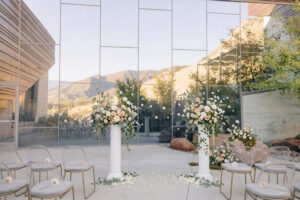
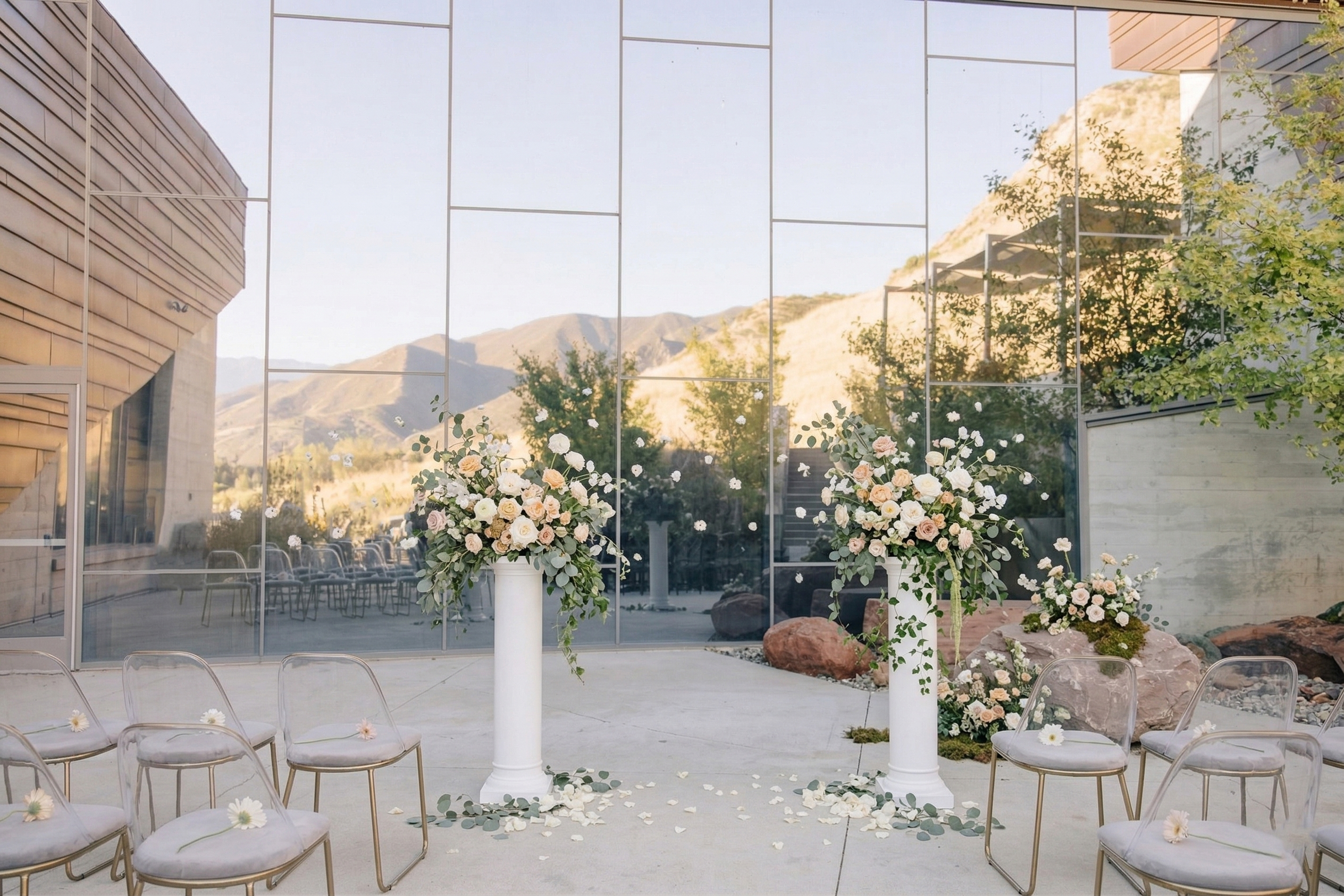
The adjacent Canyon Terrace extends the indoor space outdoors when weather permits, offering the Salt Lake Valley view from outside the building — the copper panels of the exterior visible from the terrace, the valley spread below, the Wasatch rising behind. This indoor-outdoor flow is one of the Canyon configuration’s most valuable practical assets, allowing cocktail hours and portions of the reception to extend into the exterior environment while the architectural interior serves the seated dinner and dancing. With the Canyon Terrace, the Natural History Museum of Utah offers stunning indoor-outdoor flow.
Capacity in the Canyon and Canyon Terrace configuration is 400 for a cocktail reception and 180 for a theater-style ceremony. Optional Gallery Experiences — add-on access to the exhibits — can be included, allowing guests to explore the adjacent galleries during cocktail hour.
Level 5: The Sky Gallery and Native Voices Gallery
The Natural History Museum of Utah’s Level 5 provides spectacular views. For smaller weddings and more intimate celebrations, the museum’s fifth-floor Level 5 spaces offer two distinct environments with their own specific character.
The Sky Gallery is an indoor-outdoor interpretive space on the fifth floor that provides panoramic views of the Salt Lake Valley combined with the gallery’s own atmospheric subject matter — weather, stars, and the character of the sky above Utah. The gallery’s design invites guests to interact with its content while the views through its windows anchor the celebration to the specific landscape of the valley below. The Sky Terrace extends this panoramic experience outdoors. Capacity in the Sky and Sky Terrace configuration accommodates up to 110 for a seated dinner and 150 for a standing reception, with ceremonies from 6:30 PM to 11:00 PM on Wednesdays specifically.
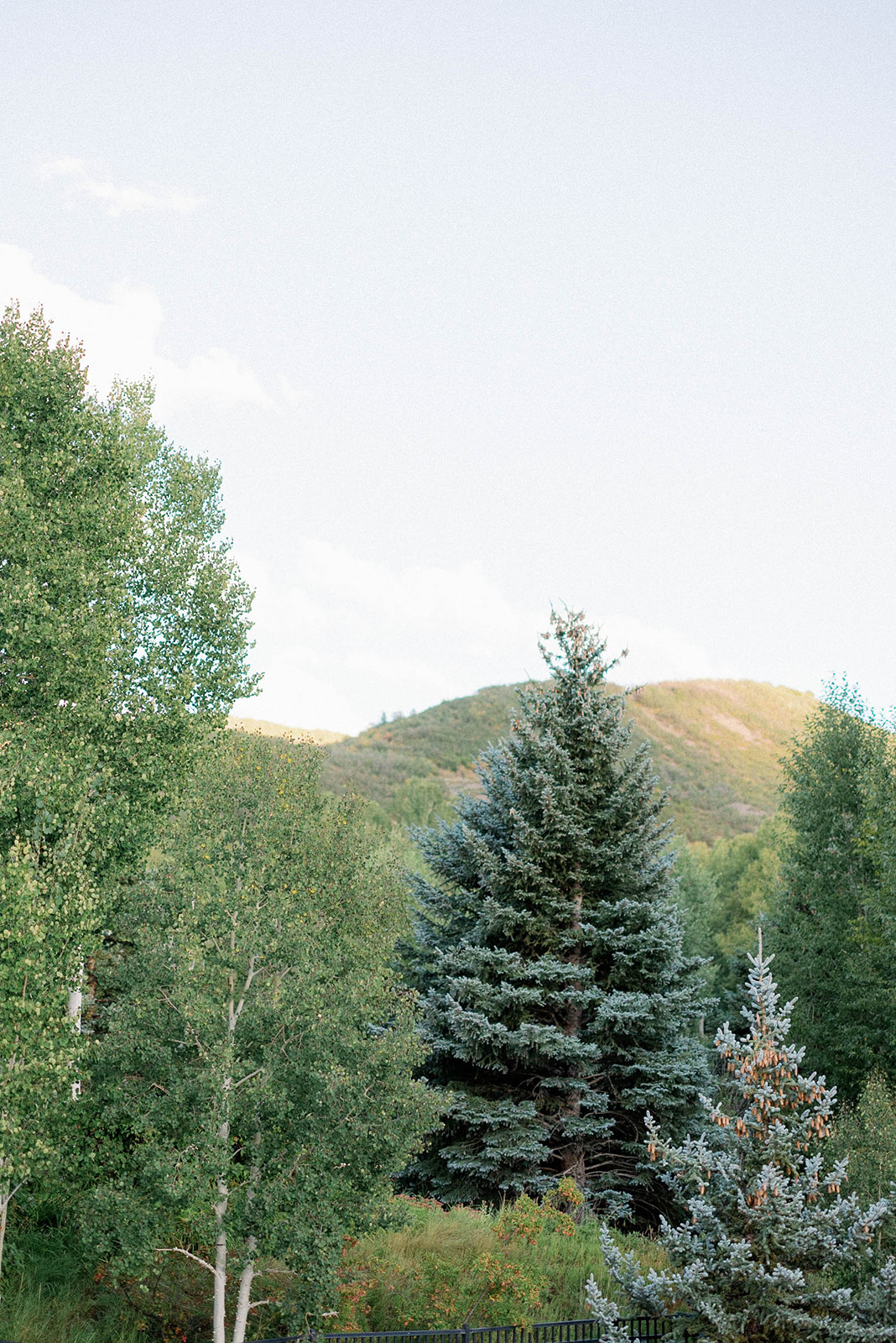
The Native Voices Gallery and its terrace is the most intimate ceremony configuration in the museum’s portfolio — a space developed in deep consultation with Utah’s American Indian communities that interprets the history and contemporary cultures of the state’s native peoples through audio, artifacts, and immersive design. The Native Voices Terrace nestled into the Wasatch foothills provides an outdoor ceremony backdrop of the mountain landscape with the building’s copper panels framing the scene. Capacity here is 60 for a seated ceremony, 120 for a standing reception — genuinely intimate in a building that more commonly hosts hundreds.
Outdoor Ceremonies: The Land Terrace
The Land Terrace is the NHMU’s primary outdoor ceremony space — positioned at the base of the building between the Wasatch foothills and the building’s copper exterior, creating a ceremony setting framed on one side by the mountain rising above and on the other by the dramatic architectural surfaces of the Rio Tinto Center. The reflections of the copper panels at different times of day — particularly in the late afternoon when the low-angle sun turns the copper from warm brown to vivid amber — create a backdrop of architectural beauty that is entirely specific to this building and this material. The Land Terrace at the Natural History Museum of Utah provides breathtaking outdoor ceremonies.
The Land Terrace accommodates 120 for a seated ceremony. As with all outdoor configurations at the NHMU, weather is a consideration, and the venue’s event team can provide guidance on backup arrangements.
Why the NHMU Photographs Exceptionally Well
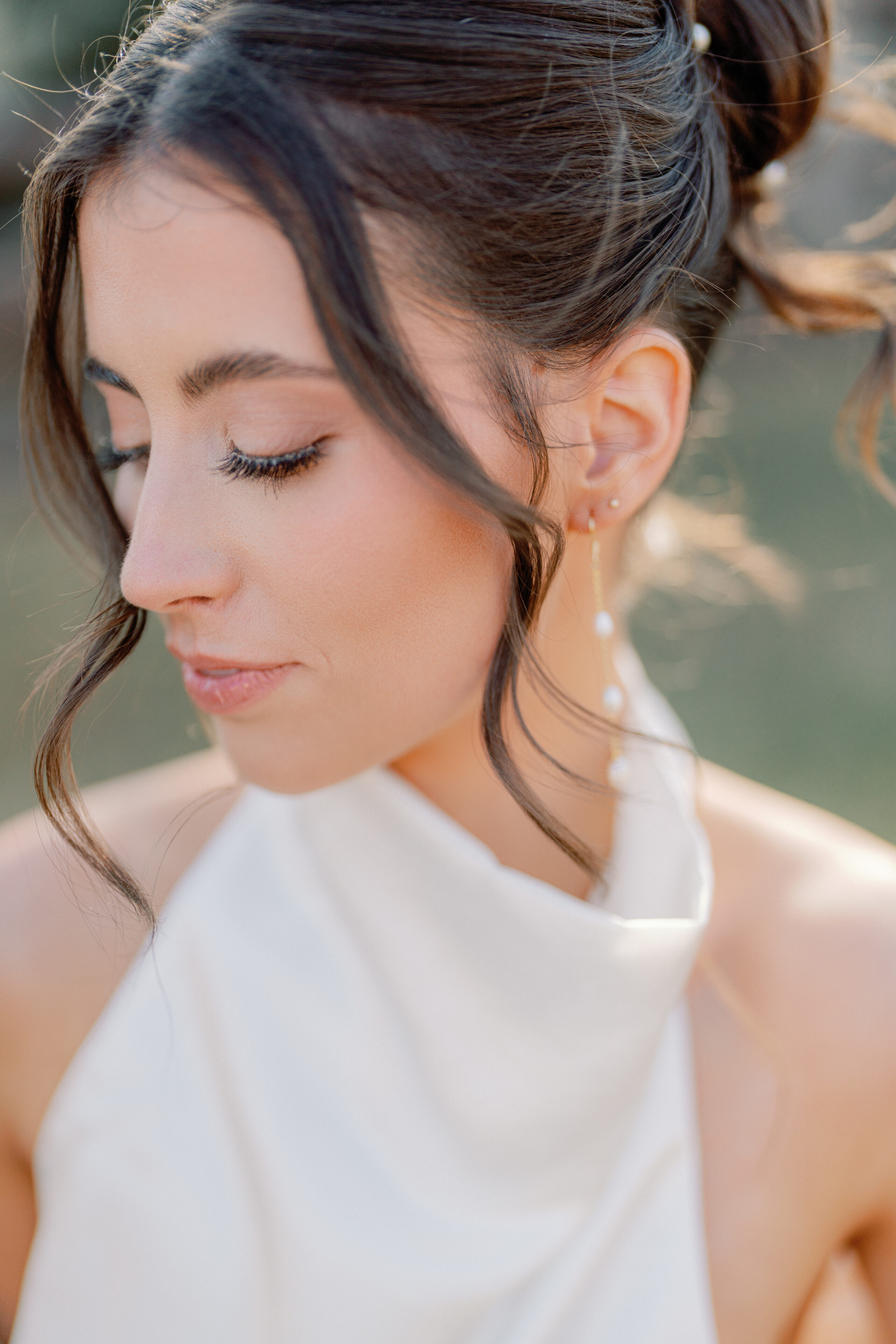
The Natural History Museum of Utah is known for its exceptional photographic opportunities.
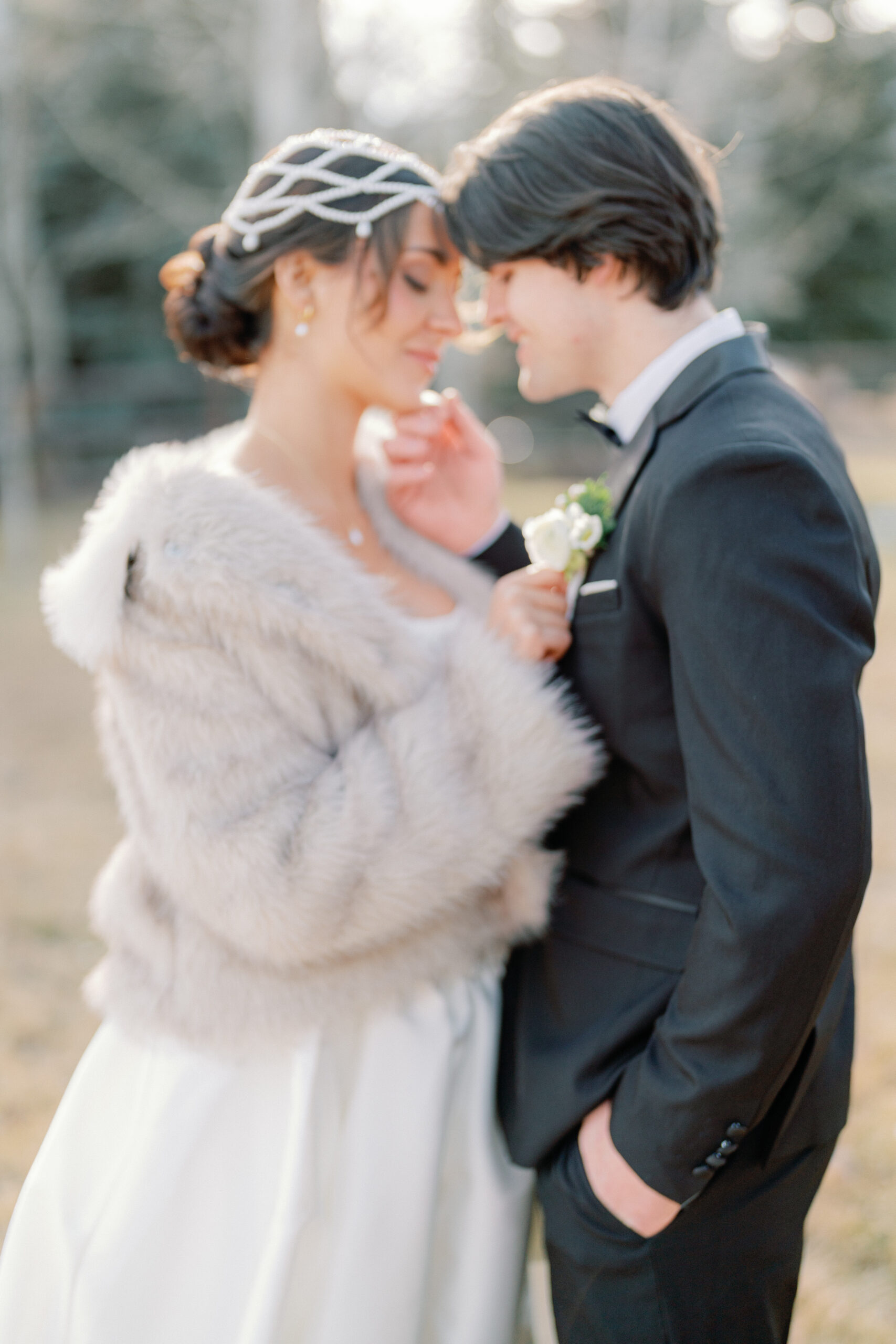
I want to be specific about this because it matters to couples making venue decisions: the Natural History Museum of Utah is one of the most photographically generous venues I work at in Salt Lake City, and the reasons are architectural rather than decorative. Each wedding at the Natural History Museum of Utah benefits from the architectural beauty.
The building is designed around light. The Canyon’s faceted walls, the floor-to-ceiling glass walls facing the valley, the carefully positioned windows and glazing throughout the public spaces — all of these create interior environments where natural light is present, directional, and continuously variable across the course of an evening.
As a photographer, what this means practically is that the quality of available light in the Canyon at different points between 6:30 PM and 11:00 PM changes more dramatically and more beautifully than in almost any indoor venue I photograph at in the state. The golden hour view through the west-facing glass wall is one of my favorite portrait moments at any Salt Lake City venue.
The transition into blue hour, when the valley lights begin to appear and the copper panels outside glow in the last available light, produces a quality of image that I cannot replicate at any other indoor venue. And the specific quality of the light in the Canyon at full evening — the city lights visible through the glass, the angular shadows on the faceted walls, the warmth of the reception setting against the cool blue of the window view — is extraordinary.
The architectural variety within a single building is the other quality I keep returning to. Portrait locations at the NHMU include the Canyon interior with:
the slot canyon walls and stream-bed floor
the Canyon Terrace with the building’s copper exterior and the valley view
the outdoor terraces at different levels with different orientations to the valley and the mountains
the gallery interiors with their scientific exhibits and their own specific atmospheric character
the building’s exterior at different positions around the 17-acre site; and the Bonneville Shoreline Trail immediately adjacent, which provides a natural landscape portrait environment within a five-minute walk of the venue.
This range of environments within a single rental means that the wedding gallery at the NHMU has a breadth of visual variety that most venue rentals cannot approach. The Natural History Museum of Utah provides diverse environments for wedding photography.
The building’s LEED Gold-aspiring sustainability design also contributes to the photographic environment in ways that are not immediately obvious: the extensive use of natural materials, the integration of the building into the hillside, and the consistent emphasis on the building’s relationship with its natural landscape setting all create an interior that feels grounded and material in a way that purely decorated event spaces do not. This materiality — the concrete, the copper, the stone-inlaid floor, the exposed structural elements — gives every image made within it a quality of genuine architectural substance that translates directly into photographs.
Practical Details: What You Need to Know
To host an event at the Natural History Museum of Utah, couples can expect top-notch service. The Natural History Museum of Utah holds one wedding per day. All celebrations begin no earlier than 6:30 PM, with vendor setup available from 5:00 PM. Events conclude by 11:00 PM. The one-event-per-day policy and the evening-only schedule reflect the museum’s daytime operational calendar and ensure that every wedding has the full building’s attention. The NHMU is closed on Wednesdays for most configurations, with the Level 5 Swaner Forum space available on Wednesdays only from 6:30 PM.
For pricing, the Natural History Museum of Utah offers competitive rates. Wedding and reception pricing including gallery access starts at $8,000 for a full ceremony and reception. Reception-only pricing starts at $6,000. Smaller space configurations are priced separately — contact the museum’s private events team at rentals@nhmu.utah.edu for current pricing across all nine configurations.
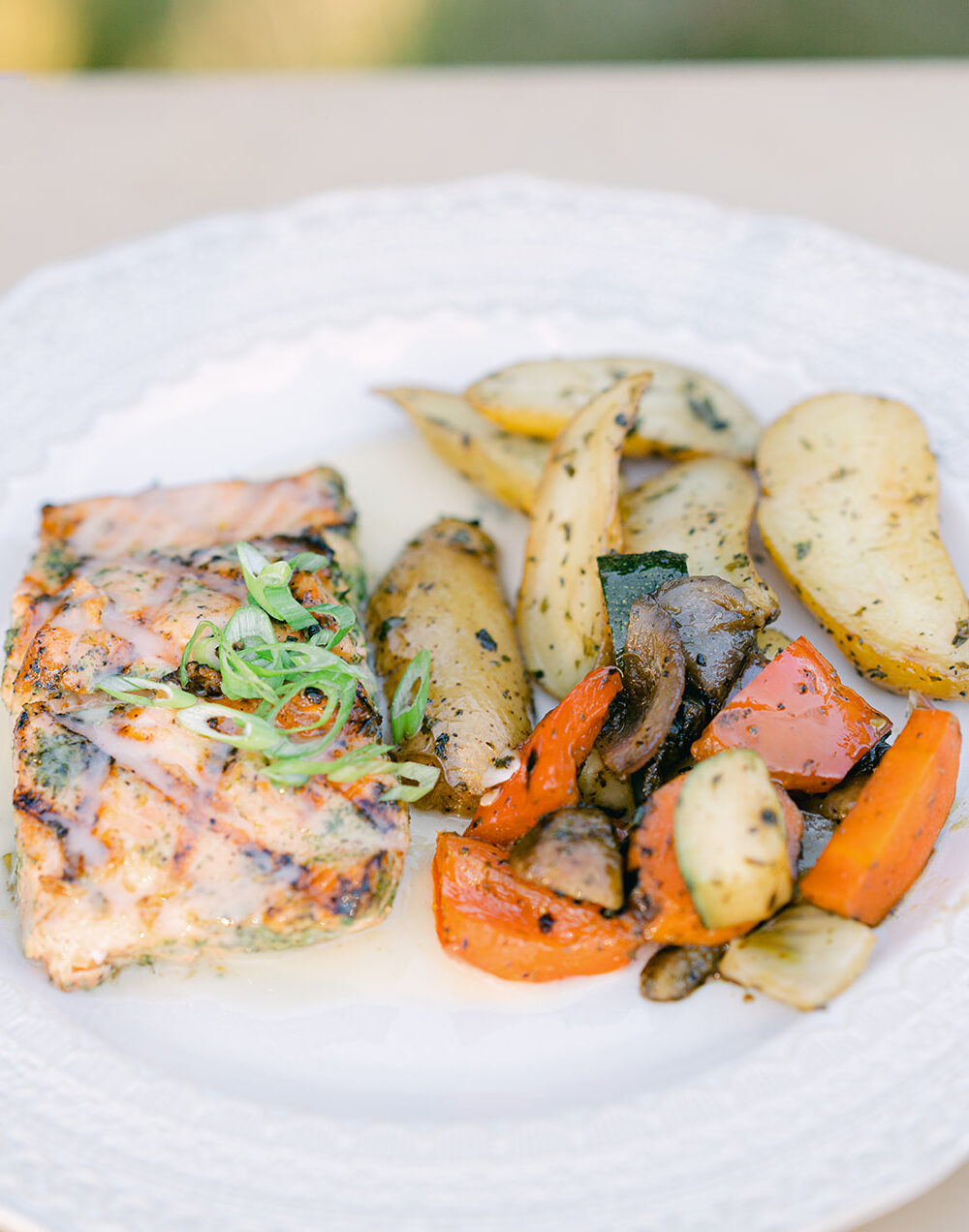
All space rentals include tables and chairs, complimentary parking at the front of the museum (large events may require additional parking arrangements), dedicated event staff, and IT staff for any audiovisual needs. Heating and umbrellas for outdoor spaces are provided and include setup and takedown. Additional services at the Natural History Museum of Utah ensure a smooth experience.
Catering at the NHMU is managed through a preferred caterer list. Outside caterers not on the list may be used with an additional $2,000 coordination fee. Alcohol is permitted through approved caterers who maintain the appropriate licensing. The museum does not allow flower petals, sparklers, balloons, confetti, or rice anywhere on the property. Florals may not be cut, trimmed, or arranged on the grounds, and no soil, moss, or bark may be brought into the venue. These restrictions reflect the museum’s responsibility to its collection and its facilities, and they are enforced consistently.
The building is fully ADA accessible throughout all event spaces. Pets may participate in ceremonies with a designated handler but are not permitted at the reception. A room can be arranged for bridal party preparation if needed — the museum does not have a dedicated bridal suite, and the events team recommends arriving with preparations complete when possible.
The Marriott University Park and the University Guest House are the closest accommodation options to the museum; downtown Salt Lake City hotels are approximately 10 minutes by car and offer a wide range of options at different price points.
The Exhibits: What Your Guests Experience
Guests will enjoy unique experiences at the Natural History Museum of Utah. When a wedding rental includes Gallery Experience access — either as part of the full museum rental or as an add-on to other configurations — guests can explore the world-class exhibitions during cocktail hour or between ceremony and reception. For most guests, particularly those attending from out of state, this is a genuinely exceptional dimension of the wedding experience.
The Past Worlds gallery is the museum’s most visually dramatic public space — a collection of dinosaur specimens including the world’s largest Allosaurus collection, complete skeletal mounts of multiple species, and real fossils displayed alongside reconstructed specimens along an elevated ramp that moves guests through the gallery in a continuous arc of discovery.
Standing beneath a full Stegosaurus skeleton or looking down at a Utahraptor found in the sandstone of Moab is an experience that most guests at a wedding cocktail hour have never had, and the conversations it generates — the curiosity it provokes, the wonder it produces, particularly in children — give the Natural History Museum of Utah weddings a quality of shared experience that purely decorative event spaces cannot offer.
The exhibits at the Natural History Museum of Utah provide exceptional experiences for guests. The Great Salt Lake gallery, the First Peoples archaeology collection, and the Native Voices gallery each add their own specific depth to the experience for guests who explore them, and the cumulative effect of an evening spent moving between world-class scientific exhibits and the celebration of two people committing their lives to each other is one that guests consistently describe as unlike any wedding they have previously attended.
Getting to the Museum
The Natural History Museum of Utah is located on the east bench of Salt Lake City above the University of Utah Research Park, approximately 4.5 miles from downtown Salt Lake and 30 minutes from Salt Lake City International Airport. The Bonneville Shoreline Trail runs directly in front of the museum. Red Butte Garden — the subject of its own venue post on this blog — is immediately adjacent, a five-minute walk away. The Natural History Museum of Utah campus is accessible from the Research Park area; detailed directions are available on the museum’s website.
The Natural History Museum of Utah is conveniently located for guests traveling from afar.
Why the Natural History Museum of Utah
Choosing the Natural History Museum of Utah means selecting a venue of excellence.
After 17 years of photographing weddings across Utah, I have learned to identify the venues that produce the specific combination of photographic excellence, guest experience, and cultural depth that creates wedding galleries and wedding memories that stand apart from the beautiful-but-interchangeable majority. The Natural History Museum of Utah is firmly in the first category.
The Canyon is one of the great architectural spaces in the American West, and getting married within it — with the faceted walls rising above and the Salt Lake Valley open to the west and the exhibits of 4.5 billion years of natural history surrounding you — is an experience that your guests will describe and remember in specific terms for the rest of their lives. Experience the stunning architecture of the Natural History Museum of Utah even if you aren’t going to choose this place for your wedding venue.
The architect who designed it said it best: in the Canyon, the building can generate its own natural history. A wedding is exactly the kind of natural history it had in mind.
If you are planning your wedding at the Natural History Museum of Utah and want to talk about photography — how to build a timeline around the evening light in the Canyon, the specific portrait environments the building offers, the Gallery Experience and how to incorporate the exhibits into the celebration — reach out through my contact page and let’s start planning together. Plan your perfect wedding at the Natural History Museum of Utah today.



add a comment
+ COMMENTS